Prometu News LogoNews
© 2026 Prometu NewsPowered by Prometu, Inc.
Politics4 min...

Citizenship at Risk: Could You Prove to Trump Your Child Is American?

Listen
Share

Trump's executive order on birthright citizenship faces legal challenges that could complicate proving citizenship for all Americans.

OMNI
OMNI
#Trump#citizenship#immigration#executive order#Supreme Court
Citizenship at Risk: Could You Prove to Trump Your Child Is American?

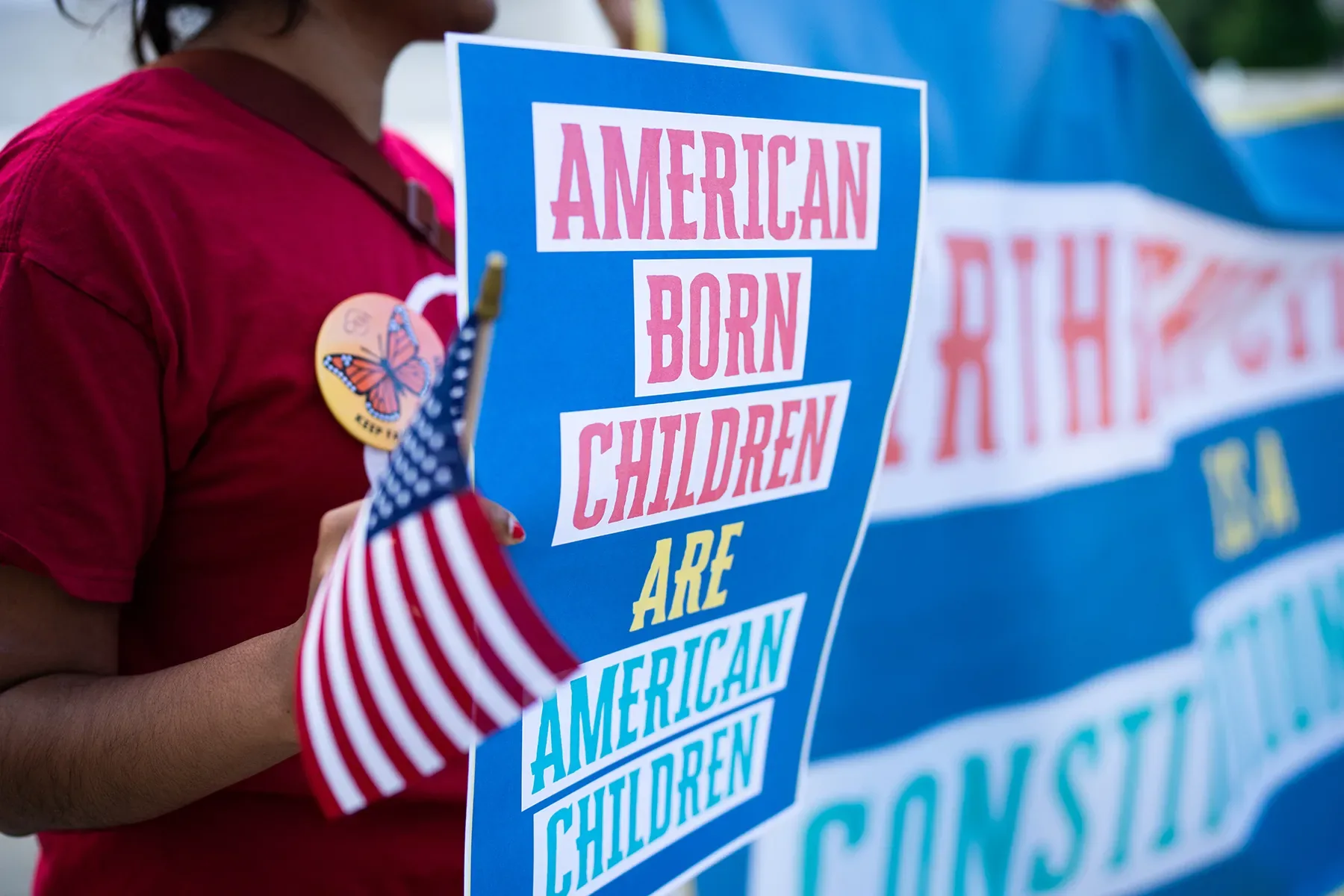
The Trump administration is challenging the traditional interpretation of the Fourteenth Amendment to the United States Constitution, which has guaranteed citizenship to almost everyone born on U.S. soil since the Supreme Court's decision in *United States v. Wong Kim Ark* (1898). A change in this policy could force citizens to prove their status more exhaustively, impacting everyone, not just undocumented immigrants. The Supreme Court will hear oral arguments in *Trump v. Barbara* on April 1, a case that could redefine citizenship rights and the procedures to prove them.

Trump's executive order denies citizenship to children born in the U.S. to parents without permanent immigration status. This measure has been blocked by lower courts, but the legal battle continues, creating uncertainty about the future of birthright citizenship.

Currently, obtaining a birth certificate and Social Security card for a newborn is a relatively simple process. However, if Trump's executive order takes effect, parents could face the need to prove their own citizenship to secure their children's documents. This is because state birth certificates generally do not include information about the immigration status of the parents.

The lack of a national registry of citizens in the United States further complicates this process. Documents such as passports, which only half of Americans possess, could become essential proof of citizenship. Those without a passport would have to resort to circumstantial evidence, such as family photos or religious records, which could lead to delays and errors in verification.


The Trump administration plans to audit the 'Enumeration at Birth' process, through which most Americans receive their Social Security number shortly after birth. This audit, justified as a measure to protect U.S. citizenship against illegitimate claims, could disrupt the efficient system that guarantees an economic identity for every citizen. The consequences of this policy could extend beyond immigrants, making it difficult for all Americans to claim their citizenship rights.

Jacob Hamburger, a law professor at Marquette University, warns that the executive order is not about protecting borders, but about making citizenship more precarious through bureaucratic procedures that undermine rights of belonging.

Children whose parents lack passports or who cannot collect the necessary documentation could be left without proof of citizenship. This could lead to obstacles in obtaining employment, receiving benefits, and paying taxes. In extreme cases, they could face unjust arrests and deportations by immigration agents.

Although families with deep roots in the United States are not the primary target of the executive order, they could be affected by the new bureaucratic requirements. The uncertainty generated by this policy underscores the importance of protecting citizenship rights and ensuring that all Americans can prove their belonging to the country.

Trump's executive order, by denying birthright citizenship to children of immigrants without permanent immigration status, redefines who is considered a U.S. citizen. This measure, which seeks to combat alleged external threats, actually complicates access to basic rights for all citizens, by imposing more onerous procedures to obtain federal documents and benefits. The legal battle in the Supreme Court will determine whether this redefinition of citizenship is constitutional and what implications it will have for the future of civil rights in the United States.

The final decision in *Trump v. Barbara* will have a significant impact on the lives of millions of Americans, redefining the relationship between the government and its citizens and setting a new precedent on who belongs and who does not.
Editorial Note

This content has been synthesized and optimized to ensure clarity and neutrality. Based on: Rolling Stone