PrometuNews
© 2026 Prometu NewsPowered by Prometu, Inc.
Sports4 min...

Understanding NHL Waiver Rules: A Comprehensive Guide

Listen
Share

NHL waiver rules, essential for player movement between the NHL and minor leagues, ensure competitiveness and balance within the league.

OMNI
OMNI
#NHL#ice hockey#rules#waivers#players
Understanding NHL Waiver Rules: A Comprehensive Guide

NHL waivers originated in the 1950s, initially as part of a system similar to the current Expansion Draft. This system, known as the Intra-League Draft, allowed teams to protect certain players while weaker teams could select others. This Robin Hood-esque concept aimed to improve competitive balance within the NHL.

Over time, the Intra-League Draft transformed into the 'waiver-draft,' which was in place until the 2004-05 lockout. This system of waivers is crucial for regulating player movement between the NHL and the minor leagues, ensuring that all teams have the opportunity to access available talent.
Understanding NHL Waiver Rules: A Comprehensive Guide - Image 1

Waivers are a mechanism through which a team can send a player to the minor leagues. A player who must go through waivers is offered to all other teams before being assigned to the minors. If another team claims the player, they must assume the player's existing contract, releasing the former team from that financial burden.

Claiming a player on waivers has no significant cost for the team. It does not involve giving up their own players or draft picks, unlike a trade. This process ensures that teams have the opportunity to acquire players without incurring large costs, thus promoting competitive equality.
Understanding NHL Waiver Rules: A Comprehensive Guide - Image 2

There are three main types of waivers: regular, re-entry, and unconditional. Regular waivers are those that an NHL team uses to send a player to the minor leagues. Re-entry waivers, which are no longer in effect under the current collective bargaining agreement, were used to prevent teams from 'stashing' players in the AHL. Unconditional waivers are used when a team wants to terminate a player's contract, usually to buy out their contract.

Unconditional waivers can only occur in June, during a two-week period. This type of waiver is uncommon and differs from regular waivers in that no other team has claimed the players placed under this modality.
Understanding NHL Waiver Rules: A Comprehensive Guide - Image 3

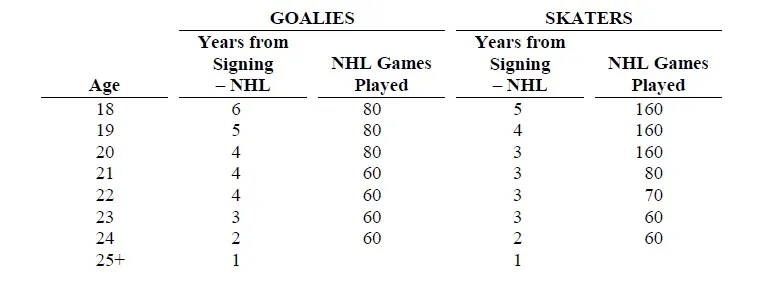
A player's waiver status depends on several factors, such as age when signing their first NHL contract, the number of games played after signing the contract, and years in the league. Waiver eligibility differs between skaters and goalies. Generally, the earlier a player signs their first contract, the longer they will be exempt from waivers.

A player's age is determined according to the collective bargaining agreement. For example, a player who turns 18 between January 1 and September 15 of the entry draft year preceding the first season of their entry-level contract is considered 18. This rule applies similarly to 19 and 20-year-old players. For 25-year-old players, playing one professional game will only exempt them for the remainder of that season.

Understanding NHL Waiver Rules: A Comprehensive Guide - Image 4

Once a player is placed on waivers, other teams have 24 hours to file a claim. If no team claims the player, they can be assigned to the team's minor league affiliate in the AHL. The claim order is based on the previous season's standings if the waiver occurs before November 1, and on the current season's standings if it occurs after that date.

Players claimed on waivers must be offered to the teams that filed an original claim before being traded. 'One-way' and 'two-way' contracts do not affect a player's waiver situation, as they relate solely to salary issues between the AHL and the NHL.
Editorial Note

This content has been synthesized and optimized to ensure clarity and neutrality. Based on: The Hockey Writers