Prometu News LogoNews
© 2026 Prometu NewsPowered by Prometu, Inc.
Politics2 min...

Reform's Polling Peak Passed, Surveys Indicate

Listen
Share

Recent polls reveal a clear downward trend in support for the Reform party, marking a significant shift in the political landscape.

OMNI
OMNI
#Reform#Polls#British Politics#Elections
Reform's Polling Peak Passed, Surveys Indicate

After months at the top of the polls, the Reform party is consistently losing support.

This trend has become evident in recent weeks, with a notable drop in their numbers.

Various factors could be contributing to this situation, including controversies and increased public scrutiny, according to political analysts.
Reform's Polling Peak Passed, Surveys Indicate - Image 1

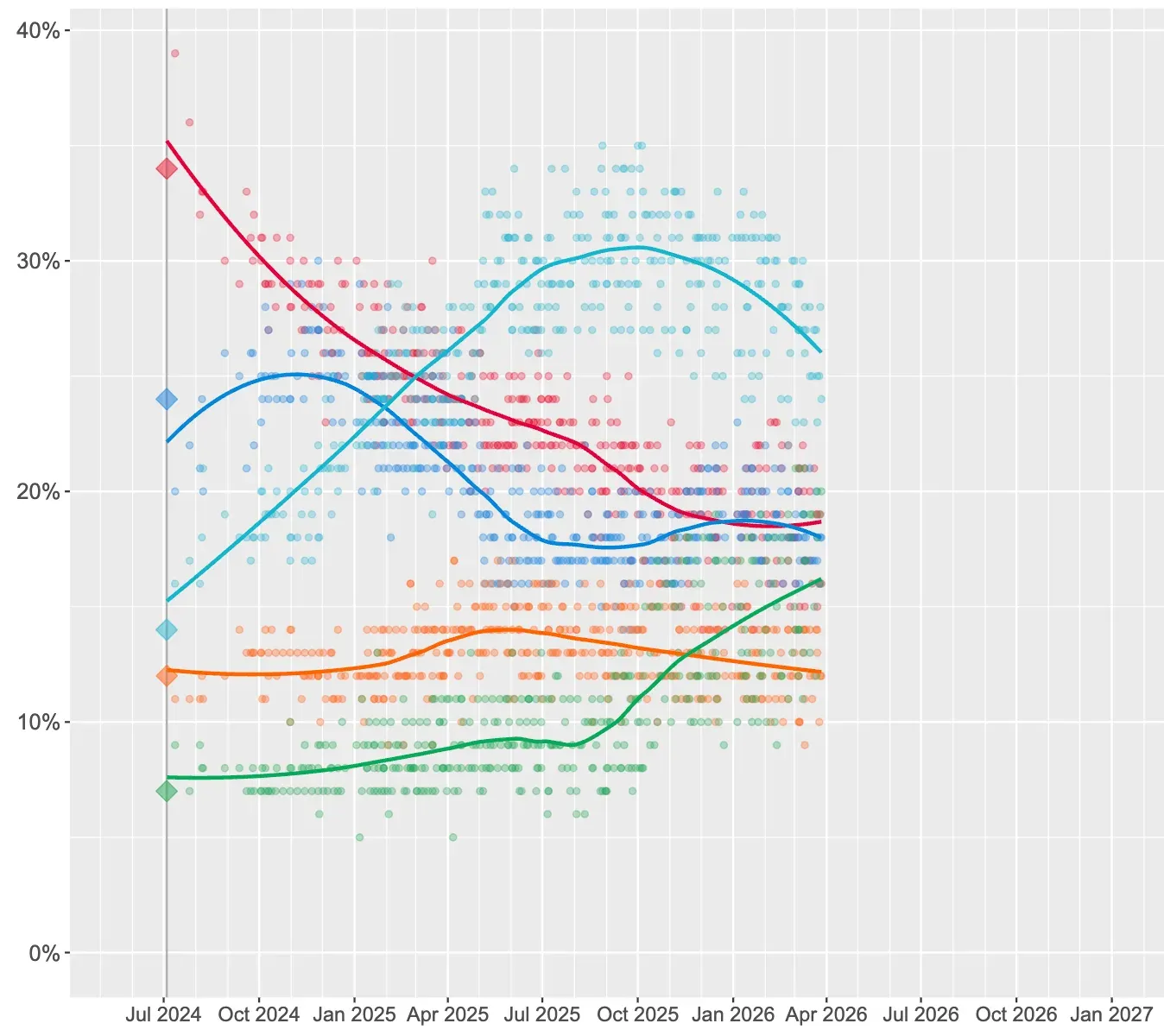
A graph visually summarizing polling data has gone viral, showing Reform's clear downward trend.

This graph, available on the Wikipedia page that collates polls for the next UK general election, presents a trend line illustrating the decline in support for the party.

Reform's peak in the polls, which was in the 30 percentage points, seems to be a thing of the past.


On social media, the news of Reform's decline has generated various reactions.

An X account commented that Reform is "sliding big time" in the polls.

Some users interpret the data as definitive proof of the party's downward trend.

Some observers point out that the rise of another party reflects Reform's decline.

This dynamic suggests that a significant part of the electorate may be looking for a populist alternative.

The analysis of these electoral movements will be key to understanding the next elections.

Social media reactions to Reform's decline are diverse, but generally confirm the trend.

An X user said that for a long time they dismissed the idea of a Reform decline, but now it seems a statistically significant reality.

This shows that the situation has reached a point where it is considered a major change, and not just noise in the polls.
Editorial Note

This content has been synthesized and optimized to ensure clarity and neutrality. Based on: The London Economic