The finale of Ryan Murphy's series, 'Love Story,' has revived the tragic story of John F. Kennedy Jr., Carolyn Bessette Kennedy, and her sister Lauren Bessette, who lost their lives on a hot, overcast day in July 1999.
Women's Wear Daily (WWD) found itself at the center of the drama, facing the difficult task of reporting on the tragedy. WWD's coverage reflected the nostalgia for the Kennedy's Camelot, an ideal deeply rooted in the society of the time, but already lost.
This event recalled the untimely deaths of figures like Gianni Versace and Princess Diana, raising questions about how the media industry should approach the situation.
WWD, with its institutional memory, approached the situation with prudence, recalling its extensive coverage of the Kennedy family since Senator John F. Kennedy married Jacqueline Bouvier on September 12, 1953. The publication had documented the evolution of the family, marking the beginning of an aspirational and inspirational era known as Camelot.
John B. Fairchild, of WWD, was fascinated by Jacqueline Kennedy Onassis, whom he nicknamed 'Jackie O' after her marriage to Aristotle Onassis in 1968. Jackie had mastered the art of managing the press, carefully orchestrating each public appearance.
This media management was crucial to the family's public image, and WWD understood the importance of discretion and respect in its coverage.
In 'Love Story,' JFK Jr. is portrayed as someone who, apparently, accepted the attention of the paparazzi, unlike Carolyn, according to her friend and designer Gordon Henderson revealed to WWD. WWD understood this difference, an experience they had already had with Jackie O, and chose to cover the couple with the same caution and discretion they had previously shown with Jackie.
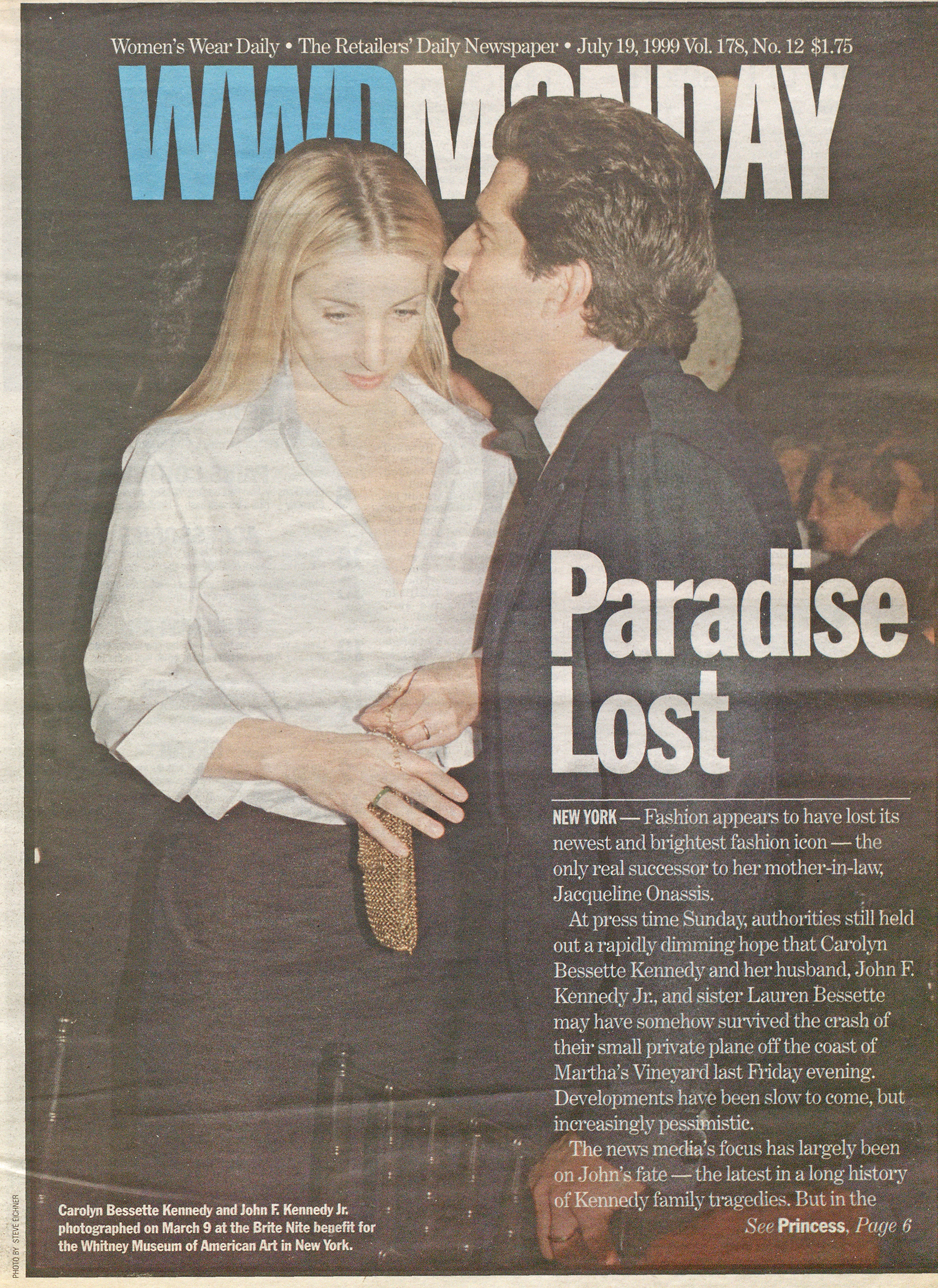
This understanding led WWD to choose an intimate photo of the couple for the obituary cover, before the official announcement of their death on July 19, 1999, with the headline 'Paradise Lost'. Carolyn Bessette Kennedy emerged as a stellar figure, potentially Jackie's successor, demonstrating the same intensity in managing the balance between the public and private spheres.
WWD's decision to honor the moment with respect and restraint reflected its commitment to journalistic ethics.
The choice of the cover, with the intimate image of the couple and the headline 'Paradise Lost,' was a reflection of WWD's understanding of Carolyn's importance. The publication recognized that, had it been different, Carolyn could have been the true successor to Jackie's legacy, by demonstrating the same ability to balance public and private life.
This decision underscored WWD's sensitivity to privacy and respect, especially in a time of great grief and media attention.
WWD remained true to its commitment to report with caution, honoring the memory of the couple and their impact on culture.
Ultimately, WWD was committed to honoring the moment with moderation and respect within its sphere of influence. The coverage of the tragedy reflected the complexity of the relationship between the media and the Kennedy family, and the importance of journalistic ethics in times of crisis.
The story of JFK Jr. and Carolyn Bessette Kennedy remains a reminder of how the media can influence public perception and the importance of responsibility in covering tragic events.
WWD's choice to focus on intimacy and loss, rather than sensationalism, demonstrates a commitment to journalistic integrity.
Editorial Note
This content has been processed by our team to ensure neutrality and journalistic clarity. Based on:WWD