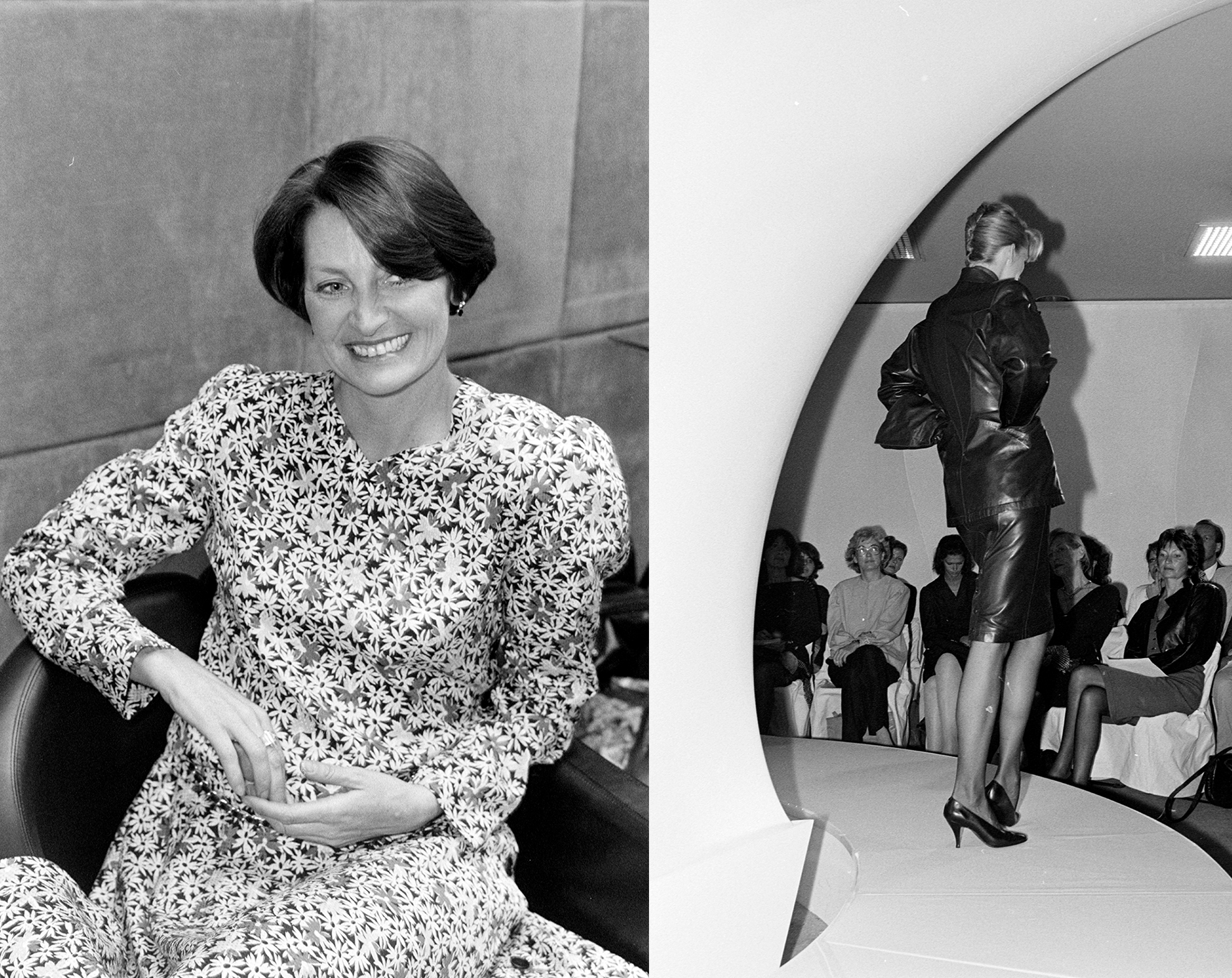
Maud Frizon, a visionary in shoe design, debuted in 1970 with the opening of her first boutique in Paris' Latin Quarter, named France Favor. She later rebranded as Maud Frizon. Alongside her husband and business partner, Luigi de Marco, the brand thrived for three decades. Frizon was known for her bold and unconventional approach, combining vibrant colors and playful details, which made waves in the footwear and accessories world. Her most distinctive innovation was the "cone heel," a design that combined style and comfort, especially popular in the 1980s.
This heel became an instant favorite, featured in her pumps, sandals, and boots, worn by trendsetters and celebrities alike. Cher, for example, was known to scoop up dozens of pairs in a single shopping trip.
By 1977, Maud Frizon was lighting up runways in Paris, New York, Rome, and beyond, showcasing her designs in high-end stores like Donald Pliner in Beverly Hills and Bergdorf Goodman in New York. The brand celebrated runway collaborations with renowned designers such as Sonia Rykiel, Missoni, Gianni Versace, Thierry Mugler, Claude Montana, and Azzedine Alaïa. Her influence can also be seen in the early creations of Christian Louboutin, who was her freelance collaborator.
Footwear News closely followed Frizon's meteoric rise, documenting her impact on the fashion world.
In 1982, FN interviewed Frizon in "Maud Frizon: An Unorthodox Approach," celebrating her 10 years in the business and the opening of a boutique on Madison Avenue, at 40 East 57th Street. During the interview, Frizon stated: "For my customer, shoes are the most important accessory in dressing. She could be young or older and more sophisticated, but she is very fashion conscious."
Maud Frizon's clientele was not only fashionable but also confident in their style, as the designer's designs were unique and somewhat avant-garde.
Frizon's unconventional approach posed challenges at the start of her business. Without formal training in shoe design, her creativity was not limited by the traditions of shoe design at the time. She faced resistance from factories when requesting unusual colors, fabrics, and heel shapes. "They told me I couldn't do it," she recalled. "They insisted it wouldn't sell."
Despite these initial challenges, she persisted, and her first collection, which included canvas boots, was well-received, especially by the fashion press. One successful collection followed another, allowing her to open her own factory and expand throughout Europe.
Maud Frizon's shoes appeared in the US eight years ago in stores like Bergdorf Goodman, Bloomingdale's, and Neiman Marcus. At that time, Frizon was selling in 30 stores nationwide, with expansion plans. Frizon explained that her inspiration came from within. "I like fantasy," she explained. The fashion industry also influenced her designs. "I work closely with clothing designers and try to adapt my shoe designs to what is happening there."
Although she always broke with tradition in her shoe designs, Frizon followed her own "rules." "I think it's important to make a shoe without adhering to set rules, except that the shoe must be comfortable and well-made. The shoe must have quality. I think nice shoes and a belt worn with a simple dress look better than a nice dress with shoes that aren't so nice. A woman looks more elegant with nice accessories... since the most important thing is the shoe." This philosophy endured for more than three decades.
Growth and international expansion led to restructuring, and Frizon sold her brand to French designer Stephane Kelian in 1992. It changed hands again in 1999, maintaining its French headquarters with a presence in Paris and Hong Kong. In 2017, Frizon's "cone heel" returned to the runways at Saint Laurent and Isabel Marant, an innovation that changed and secured the brand's legacy.
Editorial Note
This content has been processed by our team to ensure neutrality and journalistic clarity. Based on:WWD