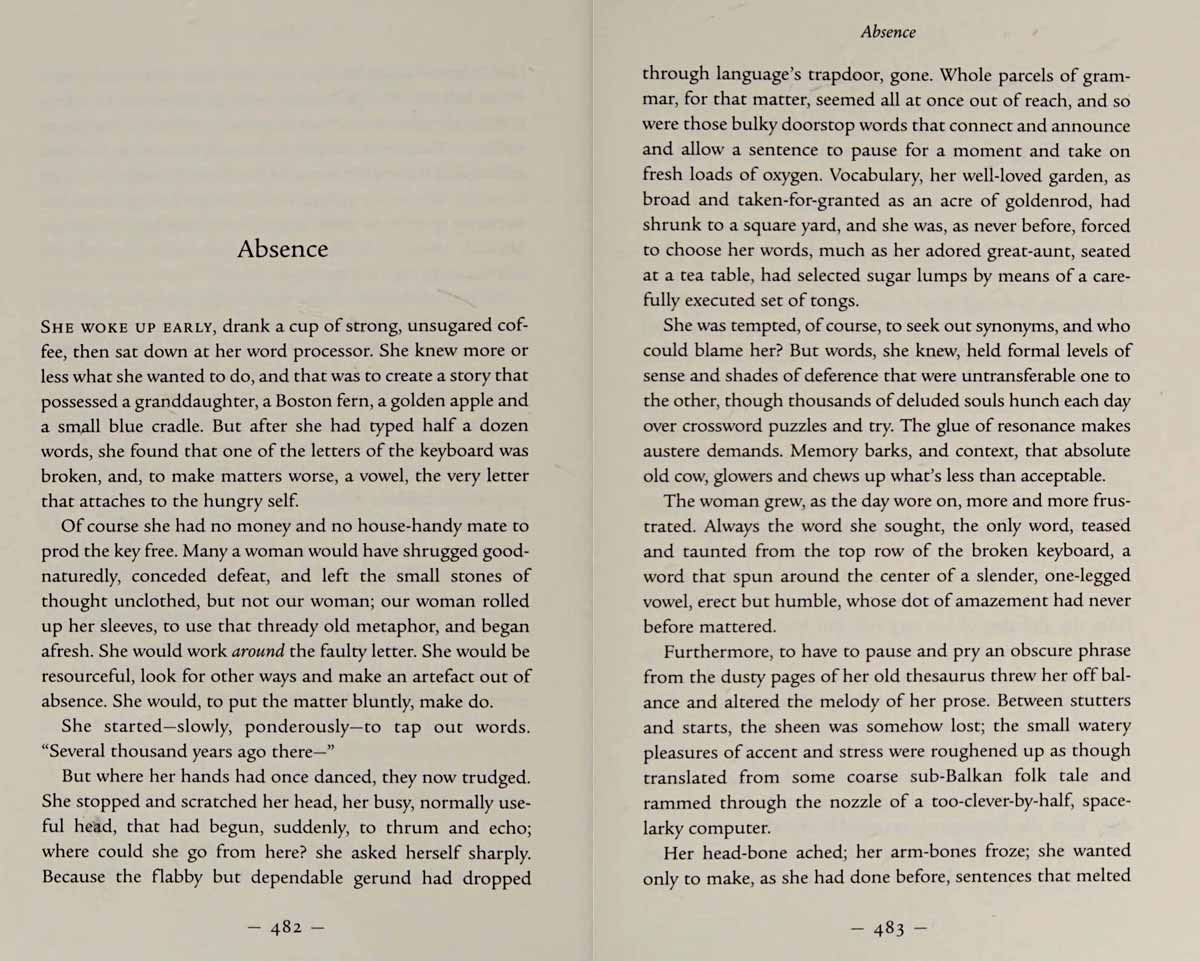
In a remarkable feat of literary ingenuity, Carol Shields, who won the Pulitzer Prize in 1995 for 'The Stone Diaries,' wrote a short story titled 'Absence' without using the letter 'I'. This linguistic challenge was published in her 2000 collection, 'Dressing Up for the Carnival,' three years before her death. The story, self-referential in nature, features a woman at her word processor, where a faulty key forces her to reinvent her form of expression. Shields' audacity lies in her ability to tell a complete story, circumventing the absence of a fundamental letter in the English language.
Shields' feat evokes the work of Georges Perec, who in 1969 wrote 'La Disparition,' a French novel without the letter 'E,' later translated into English as 'A Void' by Gilbert Adair, maintaining the same restriction. Shields' story, available on the Internet Archive, or in 'Collected Stories', which collects 22 of her short stories, demonstrates that creativity can flourish even under the most unusual restrictions.
The plot of 'Absence' focuses on a woman facing the impossibility of using the letter 'I' in her writing, an act that symbolizes the difficulty of referring to herself. The author, limited by this peculiar condition, finds new ways to express herself, as demonstrated by the phrase: 'A woman sat down and wrote, she wrote.' This approach highlights the importance of word choice and the ability to adapt in the creative process. Shields' work is not only a literary achievement, but also a reflection on identity and self-expression.
The Canadian-American writer, through 'Absence,' shows how limitations can be catalysts for innovation. This work adds to previous examples of literary restrictions, such as the 1939 novel 'Gadsby,' written without the letter 'e,' demonstrating the human capacity to overcome obstacles and explore new frontiers in the art of writing.
Editorial Note
This content has been processed by our team to ensure neutrality and journalistic clarity. Based on:Boing Boing