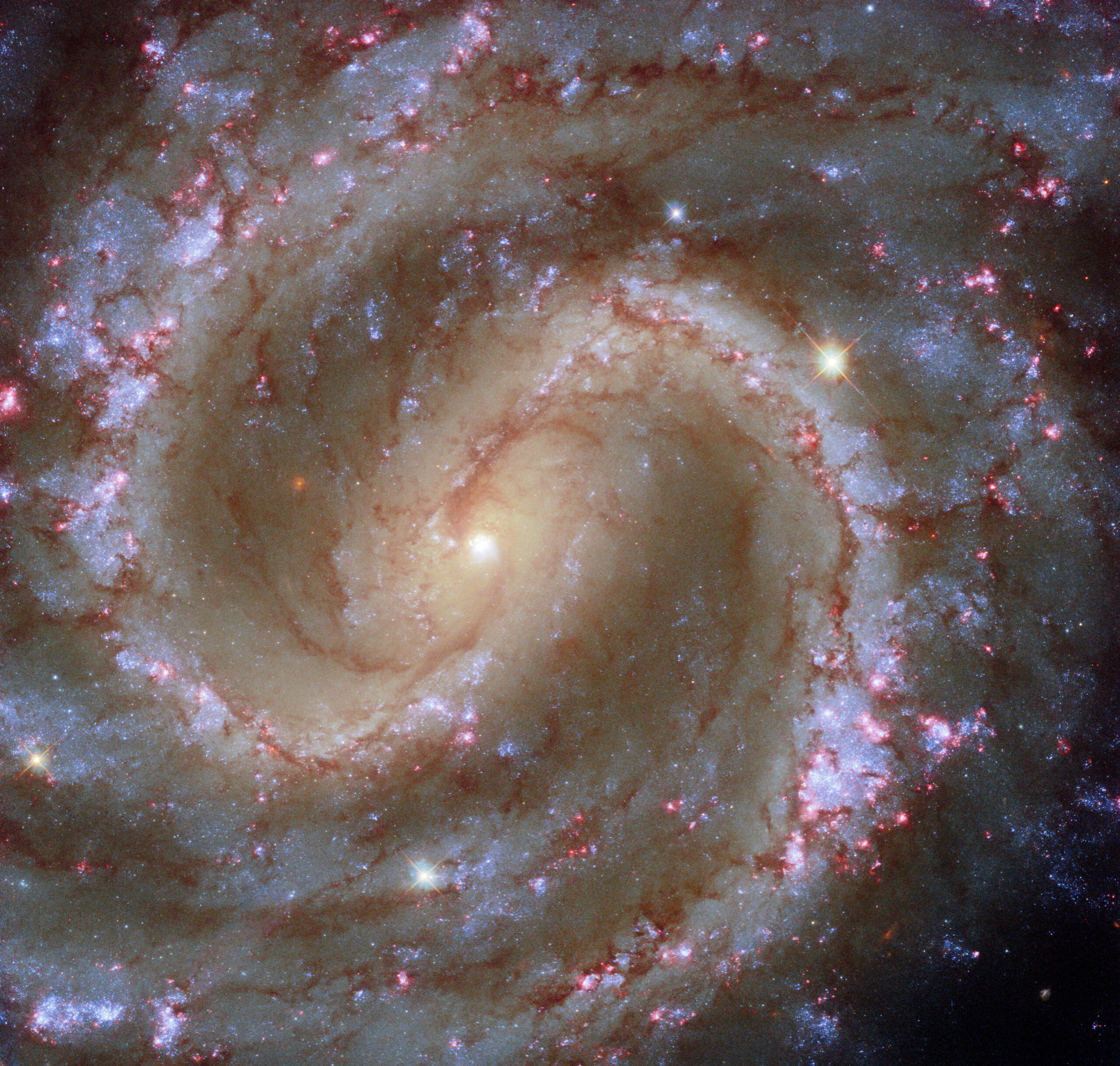
NGC 4535, located in the Virgo Cluster, is a spiral galaxy that rivals the Milky Way in size. Its impressive structure and brightness make it a fascinating object of study for astronomers. The image captured by the Hubble Space Telescope reveals astonishing details of its spiral arms, filled with bright blue star clusters and pink emission nebulae.
This galaxy, seen almost face-on from Earth, has a low surface brightness, making it difficult to observe with small telescopes. American amateur astronomer Leland Copeland dubbed it the 'Lost Galaxy' in the 1950s. Fortunately, Hubble's 2.4-meter mirror has managed to reveal its intricate structure.
The Hubble Telescope's ability to capture high-resolution images has allowed scientists to study the spiral arms of NGC 4535 in detail. These arms are packed with blue star clusters, which indicate the presence of young, massive stars. Pink emission nebulae are also observed, regions where new stars are forming.
The combination of these elements provides a unique view of the star formation processes in this galaxy. The Hubble image offers astronomers an invaluable tool for understanding the dynamics and evolution of spiral galaxies.
The study of NGC 4535 and other spiral galaxies like the Milky Way helps scientists better understand how galaxies form and evolve in the universe. The identification of star clusters and emission nebulae provides clues about star formation processes.
The information gathered from Hubble images allows astronomers to create models and simulations that explain the structure and dynamics of galaxies. This knowledge is fundamental to understanding the universe and our place in it.