Martian Mystery! Strange Phenomenon Speeds Up Mars' Rotation, Baffling NASA
Listen
Share
A NASA discovery reveals that Mars is spinning faster than expected, and the explanation may lie in an unusual 'negative mass anomaly' under its surface.
NASA's InSight lander, after analyzing years of data, discovered that Mars is spinning slightly faster each year. This finding, compared to measurements from the Viking probes of the 1970s, reveals a decrease in the length of the Martian day, albeit a minimal one. This phenomenon has sparked the curiosity of scientists, who are seeking to understand the underlying causes of this rotational acceleration. The study, published in the *Journal of Geophysical Research: Planets*, opens up new avenues for the investigation of the red planet.
This acceleration, although imperceptible in everyday life, is significant for planetary scientists, who are seeking to understand the geological and physical processes driving it. The precision of InSight's instruments has allowed the detection of these subtle variations, providing valuable information about the internal dynamics of Mars. The comparison with historical Viking data is crucial for contextualizing and analyzing the planet's rotational evolution.
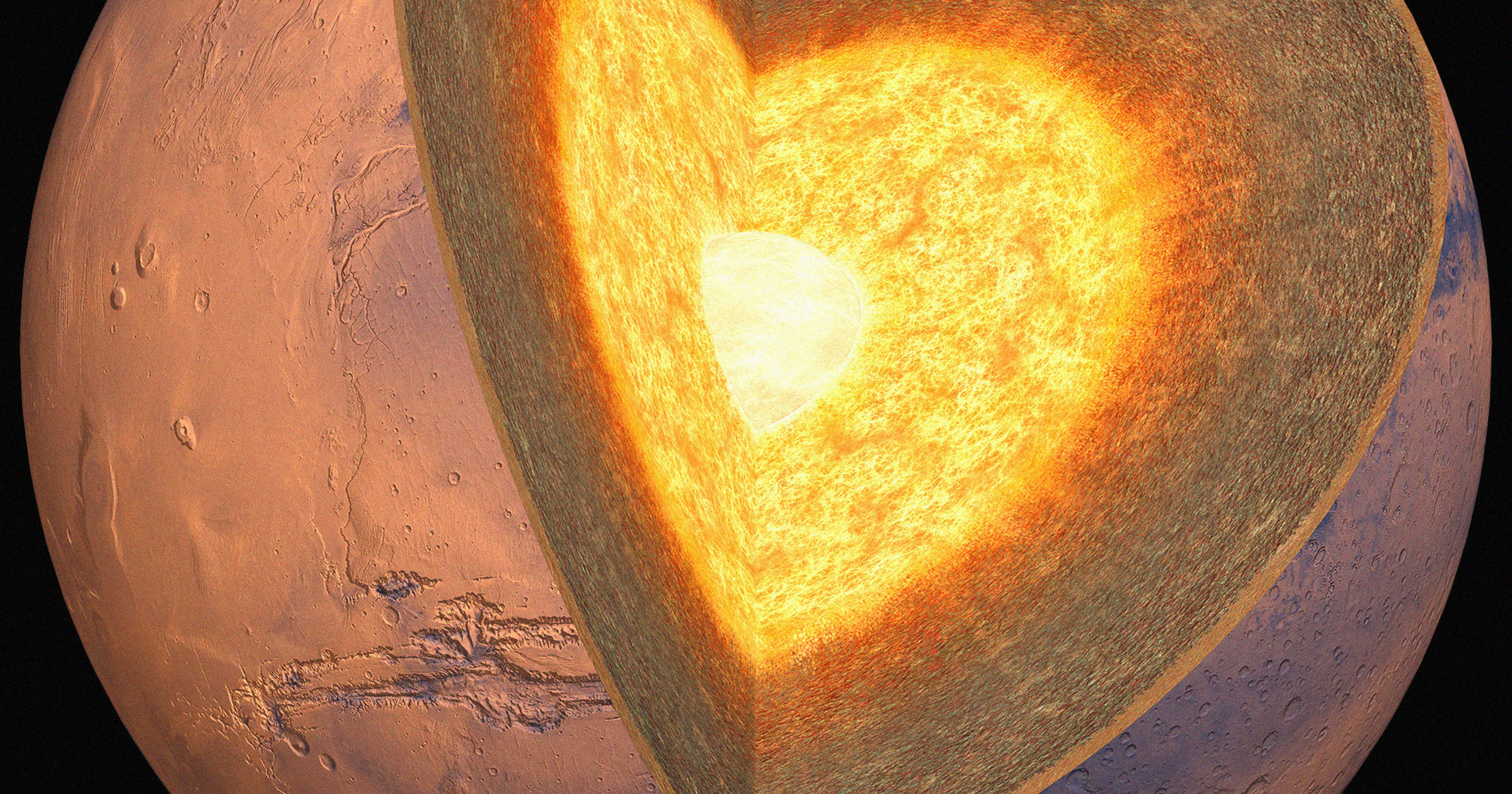
A team from Delft University in the Netherlands suggests that a 'negative mass anomaly' could be the cause of Mars' rotational acceleration. This anomaly, located deep within the planet, could be a plume of hot, buoyant material driving the rotation. The research focuses on the Tharsis volcanic province, a region with extensive volcanic activity. The hypothesis is based on computer simulations and seismic data analysis.
The study of this anomaly could reveal crucial information about the internal structure of Mars and its geological processes. The Delft University research seeks to establish a connection between the Tharsis volcanic activity and the planet's accelerated rotation. Understanding this phenomenon could help unravel the history of the solar system, according to scientists.
The research suggests that the 'negative mass anomaly' could be related to the formation of volcanoes on Mars. Less dense material rising near the equator could be replaced by denser material, accelerating the planet's rotation. Bart Root, assistant professor of planetary exploration at Delft University, explained that the anomaly, upon ascending, would impact the Martian lithosphere, generating melt pockets that could erupt as volcanoes.
This theory proposes a direct connection between Mars' internal processes and its surface, highlighting the importance of studying the planet's geology. The redistribution of mass, driven by this anomaly, could be the key to understanding Mars' rotational dynamics. The study also suggests that the interior of Mars could be more active than previously thought, with significant energy reserves.
The rotational acceleration phenomenon of Mars resembles the action of a figure skater bringing their arms closer to their body to increase their spinning speed. Heavier mass approaches the axis of rotation, resulting in an increase in speed. Root explained that, with simple calculations, the order of magnitude of the observed speed increase can be explained. More complex models will be required to establish a stronger connection. The skater analogy helps visualize how the redistribution of mass can affect the rotation of a celestial body. This phenomenon highlights the importance of studying the internal composition of Mars to understand its rotational behavior. The research continues to validate this hypothesis and better understand the dynamics of the red planet.
The skater analogy helps visualize how the redistribution of mass can affect the rotation of a celestial body. This phenomenon highlights the importance of studying the internal composition of Mars to understand its rotational behavior. The research continues to validate this hypothesis and better understand the dynamics of the red planet.
Researchers argue that the time is ripe for a dedicated gravity mission to Mars, in order to obtain answers to the remaining questions. The findings suggest that the interior of the red planet could be much more active than previously thought, with energy reserves allowing the movement of large columns hundreds of miles below the surface. The research opens new doors to explore Mars and understand its complex geology and internal dynamics.
The need for additional missions underscores the importance of space exploration and ongoing research. The data collected by these missions could reveal crucial secrets about the evolution of Mars and its relationship to other celestial bodies. The scientific community eagerly awaits future research to unravel the mysteries of the red planet.