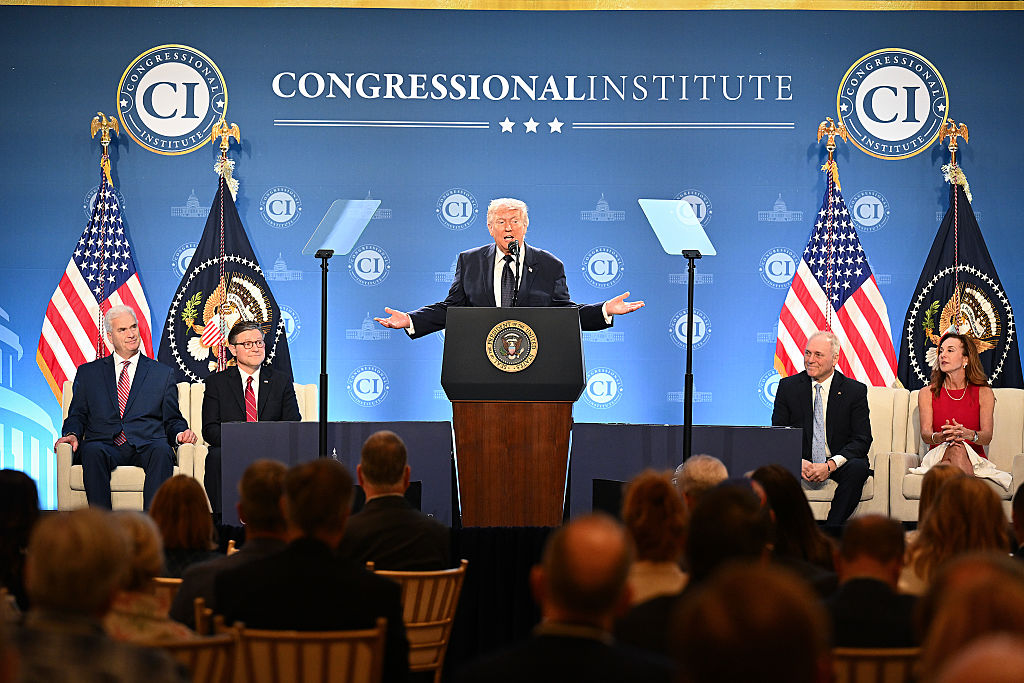
Former President Donald Trump, in a series of interviews and speeches, has sent conflicting signals about the conflict with Iran, creating uncertainty about the future of the war. In a phone interview with CBS News, Trump suggested the war was nearly over, arguing that Iranian military capabilities had been largely destroyed following strikes by the United States and Israel. He stated: "I think the war is very complete, pretty much."
However, hours later, in a speech to Republican lawmakers, Trump adopted a different tone, describing the war as unfinished and vowing to continue military pressure. He declared: "We've already won in many ways, but we haven't won enough."
This duality in his statements reflects the complexity of the situation and the difficulty of predicting the evolution of the conflict, especially in a context of growing geopolitical tensions in the region.
The former president emphasized that the United States will not cease until achieving ultimate victory, which would involve the total defeat of Iranian leaders and the military apparatus. After Iran's announcement that Mojtaba Khamenei, son of the deceased Supreme Leader Ayatollah Ali Khamenei, would assume the position, Trump expressed his disappointment and predicted that this could lead to more problems for the country. "Now nobody has any idea who the people are that are going to be the head of the country," said Trump.
In a press conference, Trump reiterated that he was "disappointed" by Iran's announcement, adding that he and other U.S. officials believed that this "would just lead to more of the same problems for the country."
These statements suggest a firm stance and a determination on Trump's part not to yield to Iran, which could prolong the conflict and increase tensions in the region.
Despite the statements suggesting an intensification of the conflict, Trump also used language that indicated a possible early exit. He described the war as a "short-term excursion" and predicted that the campaign would end quickly, stating that the United States had entered the region "to get rid of some evil".
In his speeches, Trump highlighted the military achievements of the United States and Israel, mentioning the destruction of Iran's drone and missile capabilities, as well as the supposed destruction of a large number of Iranian ships. He stated: "Together with our Israeli partners, we're crushing the enemy with an overwhelming display of technical skill and military force."
These contradictory statements create uncertainty about the duration and scope of the conflict, and suggest that Trump may be trying to balance his hard-line stance with a desire to avoid a prolonged war.
While Trump projected an image of imminent victory, the Pentagon issued signals that suggested the conflict was in its early stages. On social media, the Department of Defense posted a message that said: "We have only just begun to fight."
This stance by the Pentagon contrasts with Trump's statements and reflects divisions within the administration regarding the goals and duration of the war. Since the start of the conflict, senior officials have offered shifting explanations for the initial strikes on Iran, sometimes emphasizing Iranian nuclear ambitions, other times citing the need to protect American troops and allies, or pointing to Israel's own military plans.
The divergence between Trump's statements and those of the Pentagon highlights the complexity of the situation and the lack of a clear and unified strategy regarding the conflict with Iran.
The war has had devastating consequences for the population and economy of the region. The Iranian Red Crescent Society reported that approximately 1,300 people have died in attacks inside the country, while Iranian attacks in the Middle East have caused the deaths of more than 30 people.
Israeli strikes have also extended to Lebanon, causing the deaths of nearly 500 people and displacing hundreds of thousands of civilians, according to Lebanese officials. These figures demonstrate the devastating impact of the conflict on the civilian population and the urgent need to find a peaceful solution.
Trump stated that the world would be much safer once the war was over, but the reality is that the conflict has already caused immense suffering and further destabilized the region.