House lawmakers on Friday passed a Republican bill to fund the Department of Homeland Security (DHS) in its entirety for eight weeks. This occurred after GOP leaders rejected a Senate-passed bill that would exclude money for immigration enforcement. The partisan package was a nod to conservative immigration hawks, who hailed Speaker Mike Johnson (R-La.) for pushing it through. But it has no chance of passing the Senate and ensures that the weeks-long DHS shutdown will become the longest in history. The tally was 213-203, with three centrist Democrats joining every voting Republican in supporting the bill.
The late-night vote came after a tumultuous day on Capitol Hill, sparked by Johnson’s rejection of a bipartisan Senate deal to fund most of DHS while withholding money for immigration enforcement operations under U.S. Immigration and Customs Enforcement (ICE) and Border Patrol.
Democrats had demanded the carveout after federal officers killed two U.S. citizens in Minneapolis earlier in the year, and Senate Majority Leader John Thune (R-S.D.) ushered the bill to the floor in the early hours of Friday. It passed by unanimous consent. However, members of the far-right House Freedom Caucus immediately bashed the deal, demanding full funding for ICE and Border Patrol while pushing for a new voter ID requirement championed by President Trump. “The only thing we’re going to support is adding that funding into the bill, adding voter ID, sending it back to the Senate, make them come back in and do their work. The bottom line is, this deal is bad for America,” House Freedom Caucus Chair Andy Harris (R-Md.) told reporters.
It was clear at that point that Johnson lacked the support needed to advance the rule, which would have teed up a debate and a final vote on the Senate bill. While some Democrats said they were inclined to back both the rule and the underlying measure, such a move would have created unfavorable optics for Johnson and Republicans as rule votes are typically a test of party loyalty.
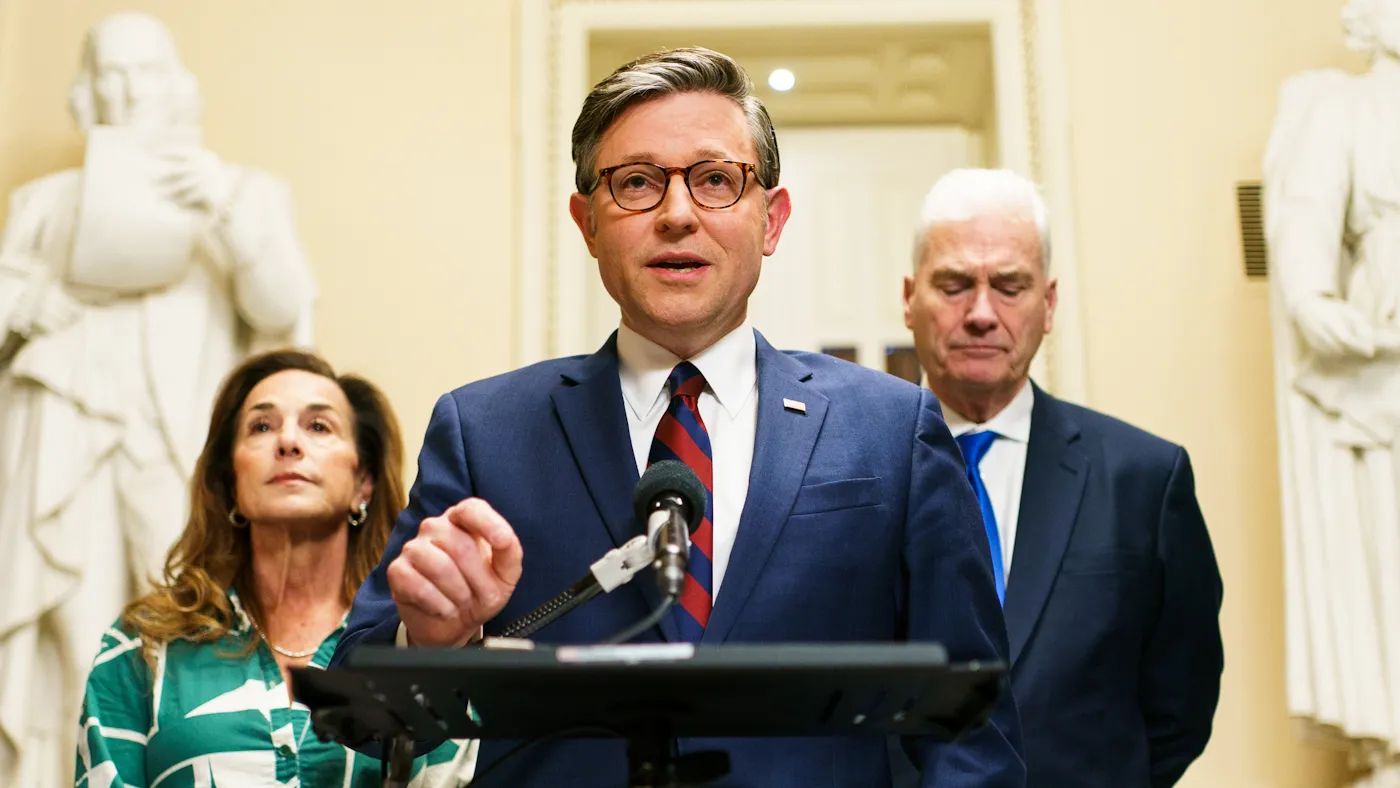
Johnson quickly shifted gears and proposed a stopgap measure that would temporarily fund DHS, including ICE and CBP, at existing levels. It ultimately earned the support of members across the conference, as reflected by the final vote, but not without some reservations. Privately, a number of GOP lawmakers voiced concerns that, by rejecting a bill that passed unanimously in the Senate, Johnson was setting up Republicans to own the shutdown in the eyes of the public. The strategy also created immediate tensions between Republicans in the House and the Senate, with Johnson taking a shot at his upper-chamber colleagues. “This gambit that was done last night is a joke,” Johnson told reporters Friday afternoon. “I’m quite convinced that it can’t be that every Senate Republican read the language of this bill.”
GOP leaders maintain that the Senate can pass the bill quickly on Monday, by unanimous consent. But Senate Minority Leader Chuck Schumer (D-N.Y.) said in a statement that the bill is “dead on arrival” in the upper chamber, as it would need some support from the minority Democrats to overcome a filibuster.
“We’ve been clear from day one: Democrats will fund critical Homeland Security functions-but we will not give a blank check to Trump’s lawless and deadly immigration militia without reforms,” Schumer said. “A 60-day CR that locks in the status quo is dead on arrival in the Senate, and Republicans know it.” Lawmakers in both chambers have now left Washington for a two-week break for the spring holidays. Thune has the power to call back the upper chamber to vote on the House stopgap measure, but the prospects are unlikely. That means the long DHS shutdown, which hit Day 42 on Friday, is destined for the record books. The idea of sending a bill to an empty Senate chamber was not overlooked by House Democratic leaders, who accused Johnson of promoting a strategy that was designed to prolong the partial shutdown.
“They know this is a continuation of the shutdown because the Senate is gone,” Rep. Katherine Clark (Mass.), the Democratic whip, said. “The Senate is gone.” Trump, who holds enormous influence over Republican votes and the fate of legislation, largely sat the debate out. After Thune passed the Senate bill just before 3 a.m., Trump declined to weigh in for hours. The long silence gave Johnson the cover to reject the Senate bill and launch the process of rallying support for the temporary alternative.
When Johnson announced his intention to bring the stopgap to a vote, he said Trump was already on board. “I spoke to the president a few moments ago; he understands exactly what we’re doing and why, and he supports it,” Johnson said. Hours later, Trump told Fox News that the Senate bill “wasn’t appropriate,” arguing that “in my opinion, you can’t have a bill that’s not going to fund ICE.” “You can’t have a bill that’s not going to fund any form of law enforcement,” he said. The president also gave Republicans cover in another way. On Friday afternoon, Trump signed an executive order that shifted funds to pay the agents of the Transportation Security Administration (TSA), who have been working without pay since the partial shutdown began on Feb. 14. During the impasse, many TSA employees have called in sick — or have quit their jobs altogether — creating chaotic scenes at airports around the country, which have been plagued by long security lines and massive delays. Liberating funds to pay those workers should ease those problems, even if it won’t happen immediately, taking an enormous degree of pressure off of lawmakers in both parties to pass a DHS funding bill that can actually become law.
Editorial Note
This content has been processed by our team to ensure neutrality and journalistic clarity. Based on:The Hill