Prometu News LogoNews
© 2026 Prometu NewsPowered by Prometu, Inc.
Politics3 min...

Trump's 'Awe' Factor: What Can Democrats Learn to Win?

Listen
Share

An analysis reveals the emotional connection of voters with Trump and how 'awe' influences politics.

OMNI
OMNI
#Trump#Politics#Elections#Democrats#Psychology#Leadership
Trump's 'Awe' Factor: What Can Democrats Learn to Win?

A 2003 paper by Jonathan Haidt and Dacher Keltner, titled 'Approaching awe, a moral, spiritual, and aesthetic emotion,' offers a surprising perspective on Donald Trump's appeal. This study, published long before Trump entered politics, explores the psychology behind awe and how this emotion influences the perception of leaders.

The document helps answer how Trump, a billionaire who seemingly uses his office to increase his wealth, manages to connect with low-income voters, even when his policies seem to contradict them. The key lies in the activation of brain areas associated with emotion, generating a response similar to that experienced before a majestic landscape or an athletic achievement.


According to Haidt and Keltner, awe is induced when two main criteria are met. First, the presence of something vast, bigger than ourselves, that diminishes our self-perception. Second, an experience that challenges or denies our mental structures, forcing us to adapt to understand it.

The combination of these elements triggers a neurophysiological response that manifests in eyes that open and shine, a raising of the head, chills, and an exclamation of surprise. This theoretical framework provides a basis for understanding how certain political figures, including Trump, can generate a strong emotional connection with their followers.

Haidt and Keltner propose that 'primordial awe' is the feeling towards a powerful figure, derived from our tribal origins, where cohesion and hierarchical leadership were essential for survival. This feeling implies reverence, devotion, and the willingness to subordinate one's own interests to those of the leader.

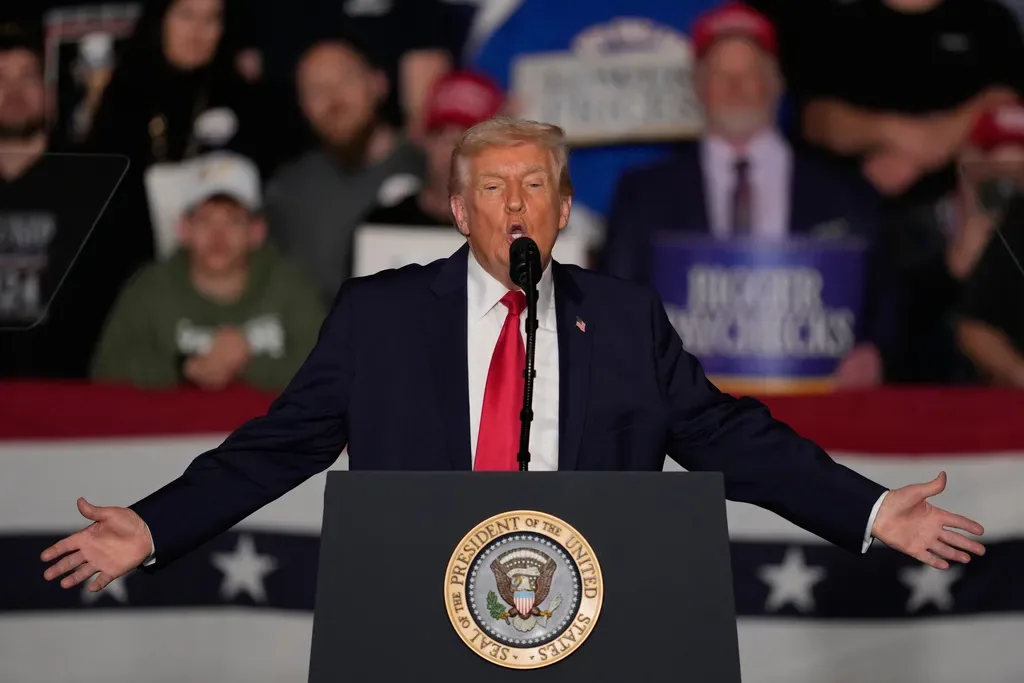
Trump cultivates this sense of awe by wielding his rhetoric from the gold-adorned Oval Office, building ballrooms, and deploying paramilitary forces, reinforcing his position in the American political hierarchy.

Trump's arrival on the political scene coincided with an electorate that felt vulnerable due to events such as 9/11, the 2008 economic crisis, scandals in institutions, the rise of social media, automation, globalization, and the pandemic. In times of vulnerability, people seek leaders who represent strength and authority, which can generate a sense of awe.

This phenomenon is not unique to Trump. Barack Obama also projected awe with his oratory and charisma. Internationally, figures like Giorgia Meloni and Volodymyr Zelensky have used their leadership to inspire and guide their nations in times of crisis.

For Democrats, it is crucial to understand that voters' attitudes are not reduced to political preferences measured in polls. Campaigns are based on data, but the 'secret ingredient' to win is the ability to inspire awe.

While policies are important, the emotion that motivates voters' behavior is a determining factor. In today's politics, the candidate who inspires awe is more likely to achieve significant victories.
Editorial Note

This content has been synthesized and optimized to ensure clarity and neutrality. Based on: The Hill