
How Could Republicans Win California’s Gubernatorial Race?
Republicans in California face the challenge of winning the governorship, needing to balance internal consolidation with the need to attract centrist voters.

#California#Politics#Elections#Republicans#Governor
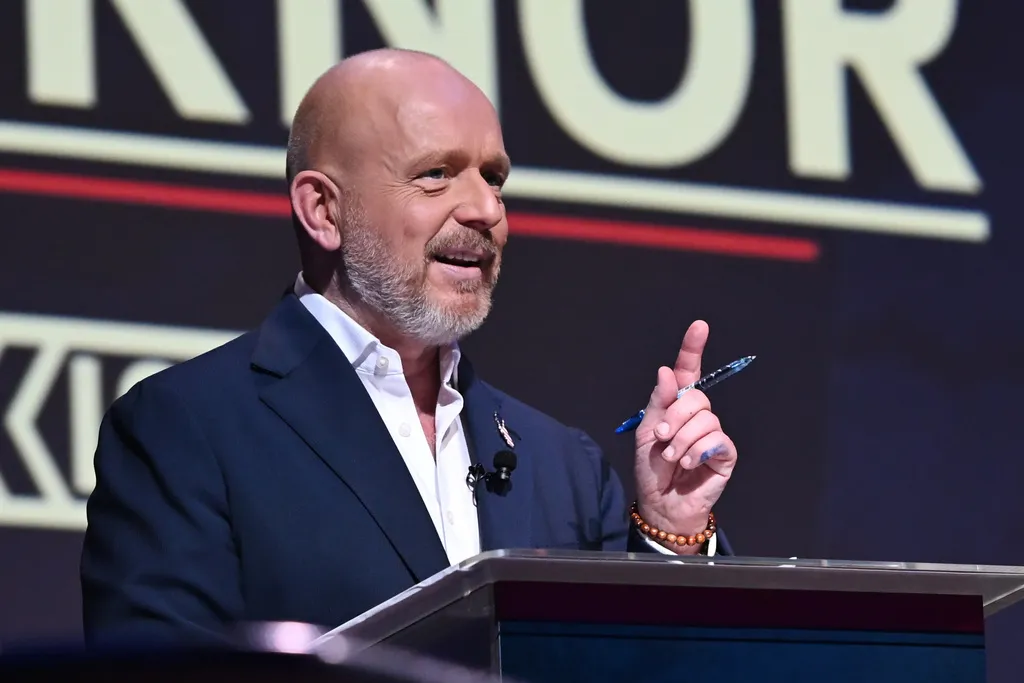
California’s 2026 gubernatorial primary poses an unusual question: Can Republicans exploit the state’s top-two system to lock out Democrats, but only by making themselves seemingly less electable for the general election? With Democrats fractured across a crowded field, there is a plausible path for the two leading Republican contenders, Chad Bianco and Steve Hilton, to place first and second. This would exclude all Democratic candidates from the general-election ballot. California’s jungle primary — with dozens of candidates set to appear on the June 2 ballot — offers Republicans this rare opening.
Even so, with Democrats setting April 14 (or so I hear) as the deadline for low-polling candidates to withdraw, the Republicans’ deeper problem remains unchanged: To win statewide, they would still need a candidate with genuine crossover appeal. Yet the kind of candidate most likely to survive a Republican consolidation fight is also probably the kind least likely to win in California.
Even so, with Democrats setting April 14 (or so I hear) as the deadline for low-polling candidates to withdraw, the Republicans’ deeper problem remains unchanged: To win statewide, they would still need a candidate with genuine crossover appeal. Yet the kind of candidate most likely to survive a Republican consolidation fight is also probably the kind least likely to win in California.
Registered Democrats outnumber Republicans in California by almost two-to-one. California Republicans have at times come closer than expected in statewide races. In the 2022 controller’s race, Republicans came within 11 points. But with only about 25 percent of registered voters, Republicans need near-total base turnout just to remain competitive for a top-two finish. That dynamic pressures the party’s two leading candidates to play to a shrinking and increasingly ideological Republican electorate. Bianco, amid slipping polls, just seized 650,000 election ballots from 2025, ostensibly to curry favor with President Trump and the Trumpiest of voters in California. Hilton, for his part, has attacked Bianco’s MAGA credentials by hammering him for allegedly taking a knee during a 2020 Black Lives Matter protest. In the race’s first debate, Hilton brushed aside the opening question to aggressively attack Bianco and urge Republican voters to consolidate behind him.
That is the central paradox of the race. Does any Republican with a plausible path through the primary now have to become, or at least present himself as, a MAGA candidate? If so, the party has constructed a mechanism that screens out the very sort of nominee who might actually compete statewide. Bianco and Hilton are not irrational actors, oblivious to California’s deep-blue reality. Nor are their appeals to MAGA voters entirely insincere. Both men plainly understand the incentives of the modern Republican electorate and, to varying degrees, are authentically aligned with it. But they are responding rationally to the structure in front of them in order to secure the nomination — notwithstanding the fact that both candidates’ campaigns are fundamentally rooted in more than Trump-era cultural signaling, offering substantive proposals to solve California’s problems of homelessness, crime and the budget.
Many of those proposals are populist: both Hilton and a progressive Democrat, Katie Porter, are running for governor on the proposal to eliminate state income taxes for families making under $100,000. But in a general election, both Republicans would likely be badly constrained if, as they have suggested, they seek Trump’s endorsement in order to consolidate the Republican vote and survive June. The strategy that may help them advance in June could all but foreclose their chances in November.
The strong opening for the California Republican Party is not simply for a Republican as such, but for a post-partisan executive: a socially moderate, managerial, tough-on-crime, tough-on-homelessness candidate in the mold of for former Gov. Arnold Schwarzenegger, someone capable of appealing to suburban voters without completely alienating the remaining GOP base. Many Californians, including some Democrats and independents, are plainly frustrated with the state’s one-party dominance and the political culture that produced Gov. Gavin Newsom (D) and former Vice President Kamala Harris. Against an establishment Democrat like Rep. Eric Swalwell (D) — who would read, fairly or not, as more of the same — such a Republican might have a genuine opening, even if the primary does not produce a lockout. Even then, such a candidate would still have to prove more compelling than left-populists like Tom Steyer and Porter, who are channeling the Bernie Sanders wing on affordability and progressive economic reform, and who may present the toughest general-election challenge of all.
There is, admittedly, a faintly comic version of this story in which Steve Hilton, a British import and consummate outsider, wins the primary, abruptly renounces MAGA, and assembles the sort of cross-partisan coalition that could win in California — whether that means sticking to populist rhetoric or abandoning it in hopes of getting some Romney Republicans on board. But political reinventions of that sort are rare and fewer still succeed. Republicans can dream. Whether they can California dream is another matter.
Related Stories


OMNI•4 min•

OMNI•3 min•