
GOP Rift: Johnson Rejects Senate Border Security Deal, Exposing Divisions
Disagreement between House and Senate Republican leaders on DHS funding reveals internal divisions and political tensions.

#United States#Politics#National Security#Republicans#Congress
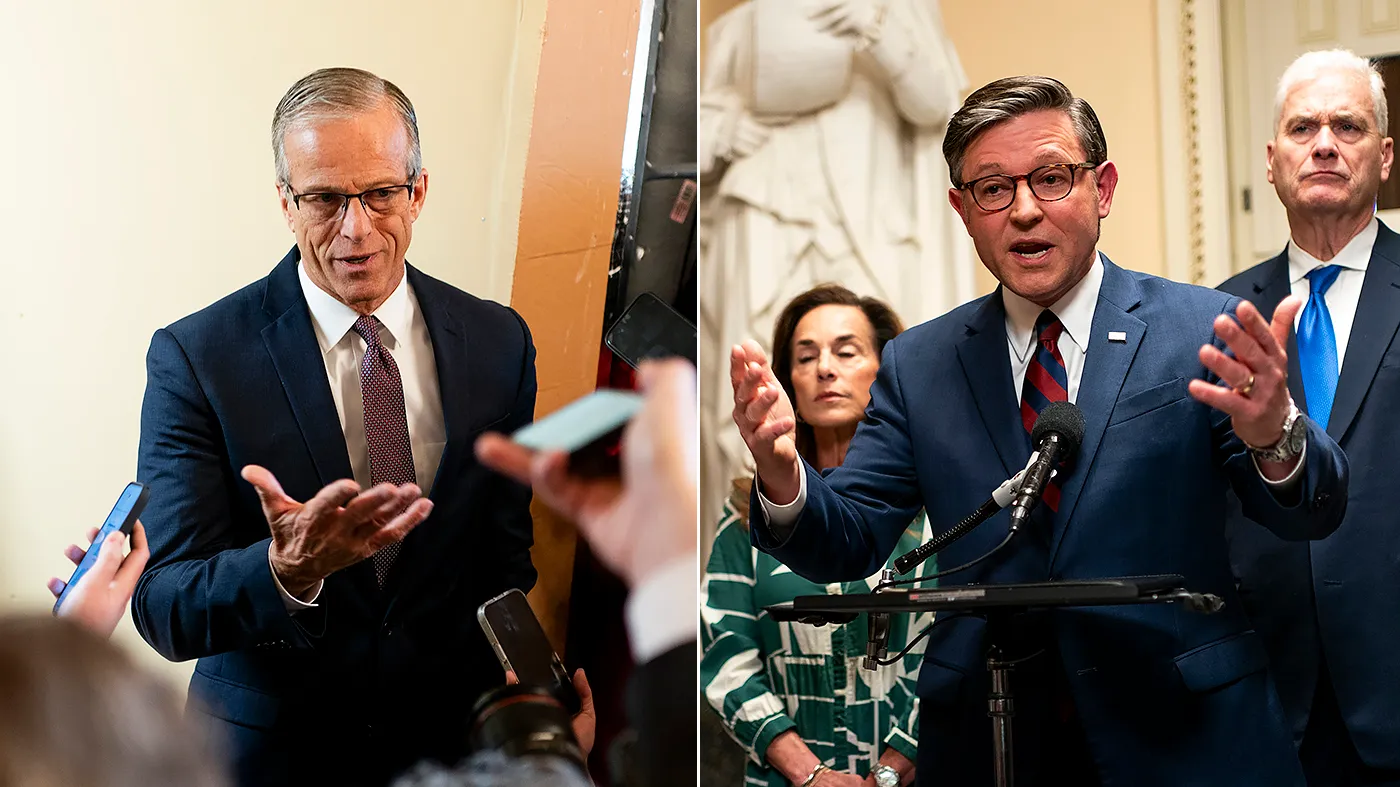
House Speaker Mike Johnson and other House GOP leaders forcefully rejected the Senate's deal to fund the Department of Homeland Security (DHS), putting Republican division on display. The Senate deal, backed by Senate Majority Leader John Thune, had passed by unanimous consent in the early hours of Friday. Johnson showed rare anger as he slammed the Senate deal, which set up a two-step process to immediately fund the Transportation Security Administration (TSA), the Federal Emergency Management Agency, and the U.S. Coast Guard. This agreement required Republicans to fund Immigration and Customs Enforcement (ICE) and border enforcement operations at a later date.
Johnson called the deal "a joke," suggesting that few Senate Republicans had read the full bill. This division exemplified the classic tension between the House and Senate, neither of which wants to be jammed by the other chamber. It also put a spotlight on the GOP leaders being out of sync, even as they would have to work together to muscle any shutdown solution through their respective chambers.
Johnson called the deal "a joke," suggesting that few Senate Republicans had read the full bill. This division exemplified the classic tension between the House and Senate, neither of which wants to be jammed by the other chamber. It also put a spotlight on the GOP leaders being out of sync, even as they would have to work together to muscle any shutdown solution through their respective chambers.
The Senate deal, which sought to temporarily fund certain agencies, was rejected by the House, leading to tensions and criticism within the party. The Senate deal to separate ICE funding had fallen apart earlier in the week. Before that, GOP leaders had slammed splitting off ICE and Border Patrol funding as a move to "defund the police." News of the Senate deal's passage Friday morning prompted immediate questions about whether House GOP leaders could push it through the House, given expected opposition from hardline conservatives and procedural hurdles.
Rep. Lisa McClain, R-Mich., expressed her shock at learning of the Senate bill's passage. President Trump, for his part, had not endorsed the Senate deal, giving GOP leaders no incentive to defy their most rebellious members and try to work with House Democrats to pass the Senate bill.
Rep. Lisa McClain, R-Mich., expressed her shock at learning of the Senate bill's passage. President Trump, for his part, had not endorsed the Senate deal, giving GOP leaders no incentive to defy their most rebellious members and try to work with House Democrats to pass the Senate bill.
Trump criticized the Senate deal in a phone interview with Fox News, calling it "inappropriate" and calling on the Senate to end the filibuster. Johnson said he had talked to Trump before announcing that the House would reject the Senate deal and instead pursue an eight-week stopgap for DHS, which is unlikely to pass in the Senate. Scalise said that as Senate Republicans find out more about the deal that passed the chamber, "they are probably hoping we bail them out by sending over the CR that funds everything."
The move to reject the Senate deal poses some risk for House Republicans if voters blame them for rejecting a bipartisan offramp. Rep. Tom Emmer warned GOP members on a conference call that it would set a dangerous precedent to defund entire programs in appropriations bills, as the Senate bill did, setting the stage for more shutdowns.
The move to reject the Senate deal poses some risk for House Republicans if voters blame them for rejecting a bipartisan offramp. Rep. Tom Emmer warned GOP members on a conference call that it would set a dangerous precedent to defund entire programs in appropriations bills, as the Senate bill did, setting the stage for more shutdowns.
The posture taken by Johnson and other Republican leaders drew praise from members of the Freedom Caucus and other hardline conservatives. Rep. Lauren Boebert, a Freedom Caucus member, expressed her pride in Johnson and Scalise's stance. Rep. Eric Burlison stated that this was the "scrappy" Johnson he knew. The White House has not commented on this situation.
The House's decision to reject the Senate deal and the subsequent response from various members of Congress underscore the complex internal dynamics within the Republican Party. The division between the House and Senate, along with the differing priorities of the members, poses challenges to governance and the party's ability to reach bipartisan agreements.
The House's decision to reject the Senate deal and the subsequent response from various members of Congress underscore the complex internal dynamics within the Republican Party. The division between the House and Senate, along with the differing priorities of the members, poses challenges to governance and the party's ability to reach bipartisan agreements.
The rejection of the Senate deal and the House's pursuit of a stopgap solution highlight internal divisions and challenges for Republican leadership. The House has a two-week recess scheduled, which could reduce public pressure. However, House Republicans are likely to get far less pressure from the public due to Trump's executive order directing DHS to find the funds to pay TSA agents. The public had mostly felt the impact of the shutdown at airports from unpaid or resigning TSA workers, resulting in lengthy security lines. If the pressure at airports is alleviated, the public might not notice much of a difference.
In summary, the situation highlights the existing tensions between different factions within the Republican Party and the difficulty of achieving consensus on key issues such as border security and government funding.
In summary, the situation highlights the existing tensions between different factions within the Republican Party and the difficulty of achieving consensus on key issues such as border security and government funding.
Related Stories

OMNI•3 min•

OMNI•2 min•