Chaos in Brazil? FIM Responds to Challenges in MotoGP's Return to Goiania
Listen
Share
The Fédération Internationale de Motocyclisme (FIM) addresses track issues in MotoGP's return to Brazil after nearly three decades, including a sinkhole and asphalt degradation.
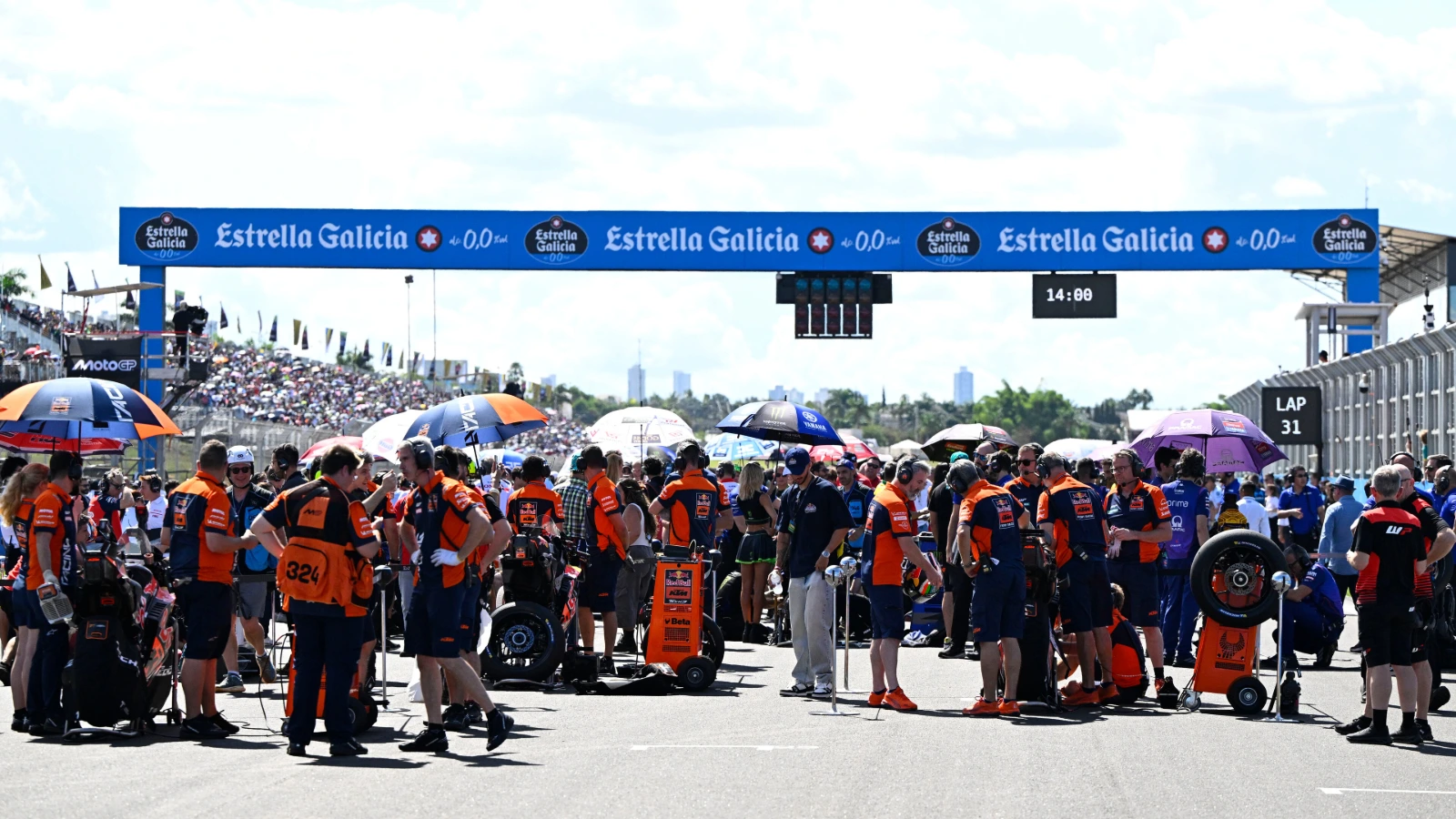
The Fédération Internationale de Motocyclisme (FIM), the governing body of motorcycle racing, has released a statement in response to MotoGP's challenging return to Brazil. The first race at the Brazilian track in almost 30 years was marked by chaos. On Saturday afternoon, a sinkhole opened up on the main straight, causing a two-hour delay to the Sprint race and forcing Moto2 qualifying to be moved to Sunday morning.
The FIM revealed that the cause was the collapse of an old sewage system under the track surface, due to heavy rainfall in the area. The FIM stated that, following the problems with the track surface, the circuit and the race promoter investigated the causes, including the unprecedented rainfall that affected the final works and contributed to the problems on the track surface.
The problem, which was fortunately off the racing line, was immediately attended to and repaired, allowing track activity to continue later that day. Six minutes before Sunday's race, it was announced that the Grand Prix distance would be shortened, without initially giving any reason. However, the FIM announced that this was due to asphalt degradation discovered after the Moto2 race finished.
Even with the reduced distance, several riders, including Alex Rins, suffered injuries and bruising after being hit by loose asphalt from the track surface. The FIM explained that the localized asphalt degradation, caused by significant heat and track activity, became apparent after the conclusion of the Moto2 Grand Prix.
Despite the removal of all excess aggregate before the MotoGP Grand Prix, a small risk of continued surface deterioration during the MotoGP race persisted. Circuit staff were working right up to the scheduled start to prepare the track, but for safety reasons, Race Direction made the decision to reduce the race to 23 laps.
The teams were immediately informed of the change by the IRTA staff on each row of the grid. The problems in Brazil were similar to MotoGP's debut in Indonesia in 2022, which also saw a reduced distance due to asphalt issues. Goiania's organizers and promoters have committed to rectifying the problems before 2027.
MotoGP's circuit homologation process is managed by the FIM and begins more than a year in advance. This includes detailed inspections of all construction areas. As each global location will require a different asphalt mix and laying procedure, these are decided by the circuit and presented to the FIM to ensure that all safety standards are met. Homologation is confirmed shortly before each Grand Prix.
The problems in Brazil were acknowledged by the promoter and the circuit, and will be rectified before MotoGP returns next season. The Brazilian Grand Prix welcomed 148,384 fans to the Autódromo Internacional de Goiania – Ayrton Senna, demonstrating both the strong appeal of MotoGP in Brazil and MotoGP's opportunity for further global growth.
The FIM oversees the homologation of MotoGP circuits and ensures compliance with safety standards. The problems in Brazil were acknowledged by the promoter and the circuit, and will be rectified before MotoGP returns next season. The Brazilian Grand Prix welcomed 148,384 fans to the Autódromo Internacional de Goiania – Ayrton Senna, demonstrating both the strong appeal of MotoGP in Brazil and MotoGP's opportunity for further global growth.