
LNG Won't Shield Hawaii From the Next Energy Crisis
A comprehensive analysis reveals that Liquefied Natural Gas (LNG) might not be the long-term solution for Hawaii, exposing it to economic and geopolitical risks.

#LNG#Hawaii#energy crisis#renewable energy
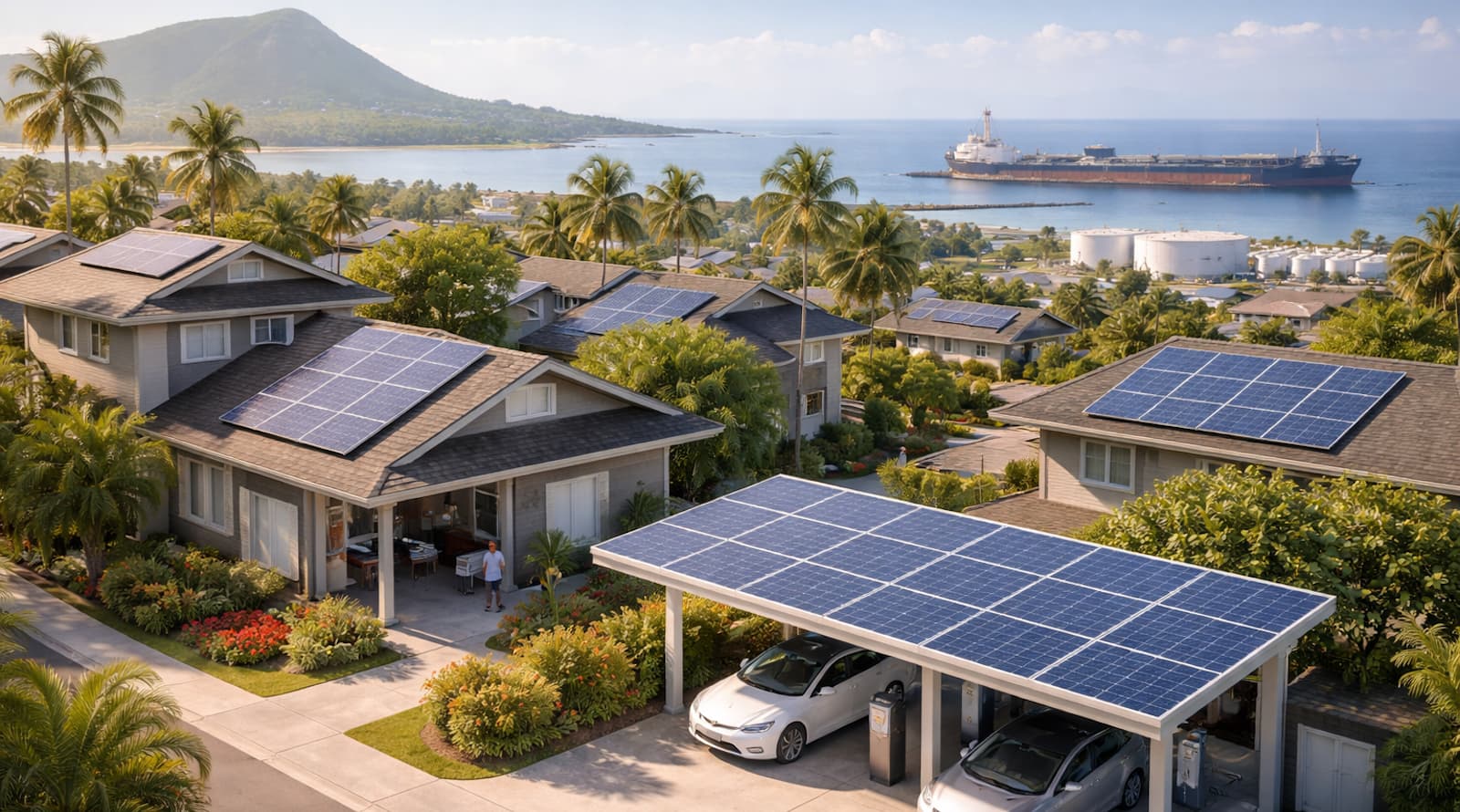
Hawaii’s bet on LNG was presented as a pragmatic response to a concrete problem: high electricity prices, aging oil-fired generation plants, isolated island grids, and political pressure to cut bills without compromising reliability. HSEO’s January 2025 alternative fuels study was built around this frame, focusing on the firm generation component of the electric grid, especially on Oʻahu. Within that framework, the study argued that an interim transition to LNG could reduce costs and emissions while supporting reliability.
In its key case, Alternative 1A, the only remaining net positive after serious modeling errors were discovered in its preferred case, HSEO stated that the benefits of an interim transition to natural gas exceeded the costs, with a net present value of approximately $150 million and levelized savings of $10.2/MWh. Governor Green’s office and JERA then built on that logic, with JERA proposing an investment of approximately $2 billion for a roughly 500 MW gas-fired plant and offshore LNG import infrastructure to address what it called Oʻahu’s affordability, sustainability, and reliability trilemma.
In its key case, Alternative 1A, the only remaining net positive after serious modeling errors were discovered in its preferred case, HSEO stated that the benefits of an interim transition to natural gas exceeded the costs, with a net present value of approximately $150 million and levelized savings of $10.2/MWh. Governor Green’s office and JERA then built on that logic, with JERA proposing an investment of approximately $2 billion for a roughly 500 MW gas-fired plant and offshore LNG import infrastructure to address what it called Oʻahu’s affordability, sustainability, and reliability trilemma.

The biggest analytical problem is that HSEO’s study was not built for crisis-era fuel economics. The study says its sensitivity analyses changed one variable at a time while all others remained constant. It explicitly acknowledges that in practice several variables would likely change at the same time, like LSFO prices and natural gas prices, which historically have shown correlation. HSEO later said the study excluded fuel-price volatility by using average fuel-cost estimates for LSFO and LNG. This matters because a volatility-free model can be directionally useful for a screening exercise, but it is not enough for a state considering long-lived import infrastructure in a world where fuel shocks have become a repeated feature of the last few years.
The International Energy Agency provides a useful historical anchor for this. Since 1973 there have been 13 episodes of sharp or sustained oil price increases, with the frequency of these events rising slightly since 2000. That works out to roughly one major price shock every four years over the full period, not as a predictable cycle but as a recurring feature of the fossil fuel system. The IEA also notes that these spikes tend to emerge when spare capacity is thin and are triggered by a combination of demand growth, supply disruption, and geopolitical events. That pattern matters for Hawaiʻi because it shows that large price shocks are not rare anomalies. They are a normal condition of globally traded fuels, and any model that relies on average prices without representing those episodes is systematically understating risk.
My hypothesis is that the long transition away from fossil fuels will not produce a smooth decline in prices. It will produce a more unstable market. As global demand growth slows and then falls, there will be deflationary pressure on average prices, but large producers and cartels such as OPEC+ have both the incentive and the history of withholding supply to defend revenue and margins when markets soften. At the same time, lower expected long-run demand and higher capital risk will make marginal projects uneconomic, shrinking the set of producers willing to invest in spare capacity and making the system more brittle. Capacity will shut down rather than be refurbished when major new capital expenditures are required. The result is likely to be a fossil fuel system with softer average pricing pressure over time but sharper and more frequent bouts of volatility, because fewer profitable barrels and molecules at the margin mean less cushion when war, sanctions, outages, or cartel discipline take supply off the market.
Long-term contracts reduce normal market noise. They do not make LNG behave like a local resilience asset when physical supply is damaged or blocked. QatarEnergy said in March 2026 that it had determined it needed to declare force majeure on some affected long-term LNG contracts. Some traders passed those disruptions through, while others honored contracts only by leaning on broader portfolios. That is the real lesson. Contract structure matters, but portfolio depth matters more once the molecules stop moving. In a true system shock, a long-term contract does not guarantee that the buyer avoids either volume disruption or price pain. It mostly determines who absorbs the first layer of the shock.
For Hawaiʻi, that matters because the islands would not be buying domestic resilience. They would be buying access to a managed global portfolio. JERA is a serious company, but its Hawaiʻi proposal remains subject to further discussions with the state. Its executives have said the company has secured the LNG needed for the early 2030s and can hedge a substantial portion of its expected volumes, yet it does not aim to become a U.S. gas producer. In other words, JERA is a large and capable portfolio manager, not a local or upstream fuel source for Hawaiʻi. That can lower counterparty-management risk. It does not remove Hawaiʻi’s exposure to global scarcity, global repricing, or cargo competition in a crisis. A trader is not a fuel source. It is an intermediary in the same stressed market.
The deeper issue is that Hawaiʻi is not just being asked to buy LNG. It is being asked to buy into a specific energy worldview. HSEO’s favorable case assumes reuse of LNG infrastructure for a hydrogen transition in 2045. JERA’s strategy rests on the idea that thermal infrastructure can be preserved and decarbonized later with hydrogen and ammonia. That is not a marginal technical detail. It is the economic foundation of the bridge argument. My own analysis of green hydrogen, hydrogen shipping, and ammonia imports for energy points to a consistent conclusion: these pathways remain structurally expensive and retain the same exposure to global energy markets that Hawaiʻi is trying to reduce. Even under optimistic assumptions, green hydrogen produced in high-resource regions tends to land well above the cost of direct electricity, and once it is converted to ammonia, shipped thousands of kilometers, cracked or burned, and turned back into usable energy, the effective cost multiplies. Shipping ammonia or hydrogen carriers adds both capital and energy penalties, and those costs are tied to the same global shipping, insurance, and geopolitical risks that affect LNG. The round-trip efficiency losses are also large, often leaving only 30% to 50% of the original renewable energy available at the point of use. That means Hawaiʻi would be paying for several units of energy upstream to get one unit delivered locally. In practice, imported hydrogen or ammonia is not a cheap or stable substitute for LNG.
For Hawaiʻi, that matters because hydrogen and ammonia do not solve the exposure problem. They persist it. Many of the jurisdictions planning large-scale hydrogen export are in the Gulf. Saudi Arabia and Oman are advancing multi-billion-dollar hydrogen and ammonia export projects aimed at global markets. If Hawaiʻi moves from LNG to imported ammonia or hydrogen, it is not escaping globally traded fuel risk. It is recreating it in another form. The 2026 war made that plain because it was not only an energy crisis. It was also an ammonia fertilizer crisis. The Strait of Hormuz carries a large share of globally traded fertilizers. Gulf producers are major suppliers of ammonia and urea, and prices rose sharply during the conflict. Fertilizer plants in the Middle East shut down or reduced output, and shipping disruptions constrained global flows. At the same time, Russia, another major supplier, suspended ammonium nitrate exports. A significant share of global ammonia trade moves through the same chokepoint. For Hawaiʻi that is a strategic warning. A fuel strategy centered on imported ammonia or hydrogen carriers remains entangled with the same geopolitical systems that produced the LNG shock.
Related Stories


OMNI•2 min•
OMNI•4 min•