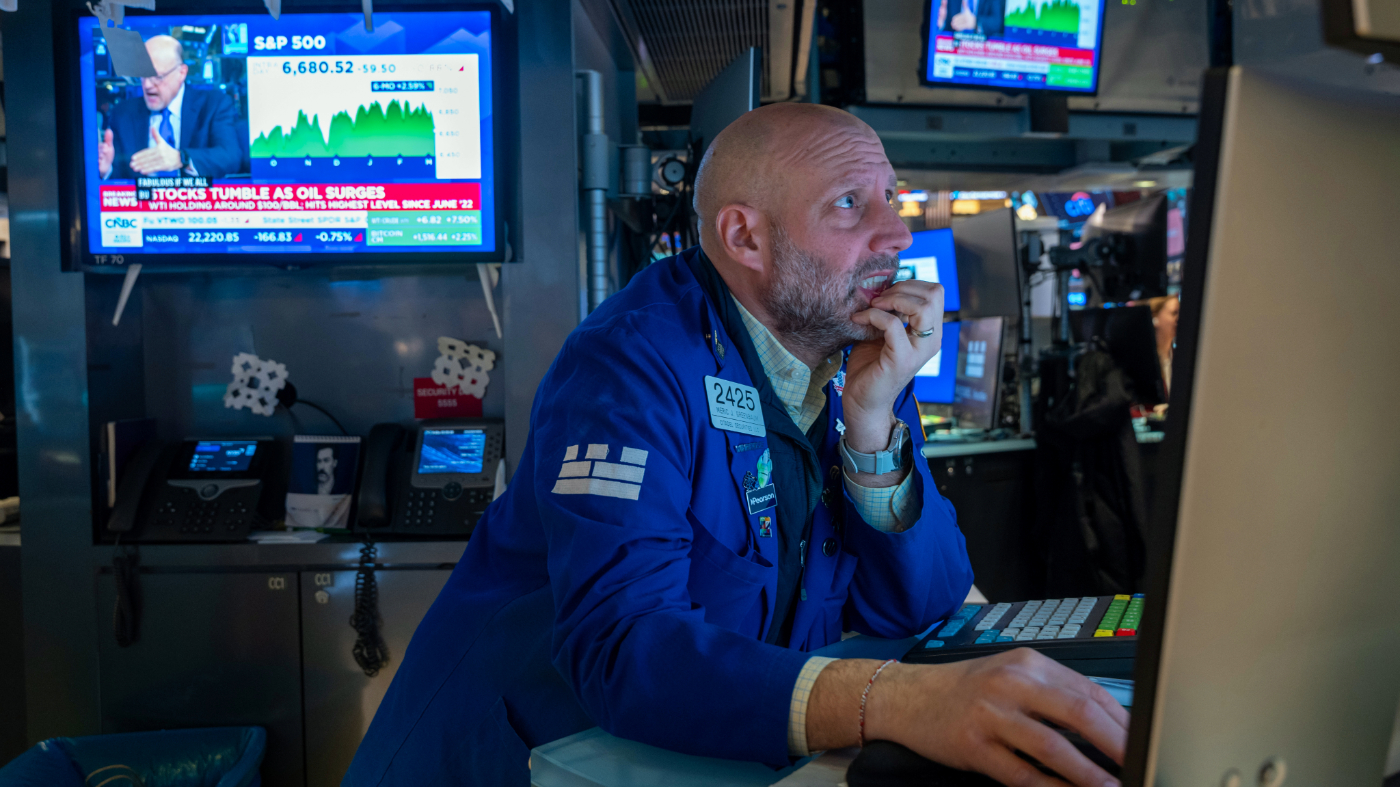
Stocks closed the week with sharp losses on Friday as Wall Street sought refuge from the financial blowback of the war in Iran.
The Dow Joes Industrial Average closed with a loss of nearly 800 points Friday, falling 1.7 percent on the day. The index closed at 45,166.64 points, down more than 10 percent from its most recent high, which is the threshold for a stock market correction.
The S&P 500 index also fell 1.7 percent on the day, and the Nasdaq composite closed with a loss of 2.1 percent Friday. The tech-heavy Nasdaq had already fallen into a correction by Thursday’s closing bell.
Friday’s losses marked the end of another difficult week for the stock market, which has buckled under economic concerns driven by the war in Iran.
Despite President Trump’s repeated insistence that the joint U.S.-Israeli operation in Iran has largely achieved its goals, the war is about to enter its second month with no clear end in sight.
The Trump administration has simultaneously sought negotiations with Iranian officials to end the conflict and deployed thousands of U.S. troops to the Middle East to back up its threats of further action against the regime.
The uncertain outlook for the war is raising concerns on Wall Street of deeper economic damage after a month of skyrocketing oil and fertilizer prices.
Iran has responded to the U.S.-Israeli attack by effectively closing off the Strait of Hormuz, choking off much of the global supply of crude oil and fertilizer.
Prices for a wide range of fuels and food products have spiked in response, raising the chance of a broader inflationary surge.
"The US-Iran conflict is taking a toll on consumer sentiment, as it has lifted gas prices substantially and caused declines in equity markets. We expect a sustained recovery in sentiment from near record lows will be delayed as long as the war persists," wrote Grace Zwemmer, US economist at Oxford Economics, in a Friday analysis.
"For now, the war is having a more muted impact on consumers’ views on future economic conditions, but that could change the longer the war persists, or when higher energy prices begin to lift overall inflation," Zwemmer wrote.
As Trump faces pressure over the economy, the White House announced a series of steps Friday aimed at bringing relief to the agriculture industry amid issues caused by the war in Iran.
Editorial Note
This content has been processed by our team to ensure neutrality and journalistic clarity. Based on:The Hill