The Federal Open Market Committee (FOMC) voted to hold monetary policy steady last week, anticipating uncertainty about oil prices since the conflict with Iran began. The interest rate projections of Fed officials remained unchanged from the December meeting, with a median expectation of one rate cut later this year.
However, Fed Chair Jerome Powell expressed concern about progress in lowering inflation, stating at a press conference that "if you don’t see progress, you won’t see rate cuts." This assessment impacted the Treasury bond market, where yields on the 10-year bond and the long bond rose to eight-month highs last week, while the yield on the two-year note was up half a percentage point to 3.9% since the war began.
How the Fed views oil shocks today is very different than during the first two shocks in the 1970s, when oil supply disruptions contributed to stagflation. Inflation had surged ahead of both oil price spikes as the global economy expanded rapidly, and the Fed significantly raised interest rates, which led to severe recessions.
Since then, the Fed’s approach has been to look through oil price spikes. For example, during Iraq’s invasion of Kuwait in August 1990, the Fed lowered interest rates as the economy slipped into recession, instead of focusing on the inflationary impact. The Fed was able to do so because U.S. dependence on imported oil declined after President Ronald Reagan’s action to abolish remaining price controls on U.S.-produced energy in January 1981.
The U.S. has recently become a net energy exporter as of 2019: the shale revolution has resulted in the U.S. becoming the world’s biggest oil producer. It is also now the world’s biggest exporter of natural gas. As a result, the U.S. economy is less vulnerable to oil supply disruptions than in the past, although it still feels the impact of higher energy prices.
The main reason is that the Fed does not want inflation expectations to rise. At his press conference, Powell acknowledged that the economy has been slammed by an unusual number of supply shocks in the past six years, and inflation has been consistently above the Fed’s 2% target. Some officials worry that the Fed’s credibility as an inflation fighter could be tarnished if it misses the target again because of the spike in oil prices.
Federal Reserve governor Christopher Waller voted to keep rates unchanged at the March Fed meeting, after having voted to ease policy in previous meetings. In an interview with CNBC, Waller acknowledged, “It’s going to be a much more protracted conflict, and oil prices are going to stay high for a longer time.” The disruption of oil supplies is the largest in history, according to the International Energy Agency, as 20 percent of the world’s oil and natural gas pass through the Strait of Hormuz.
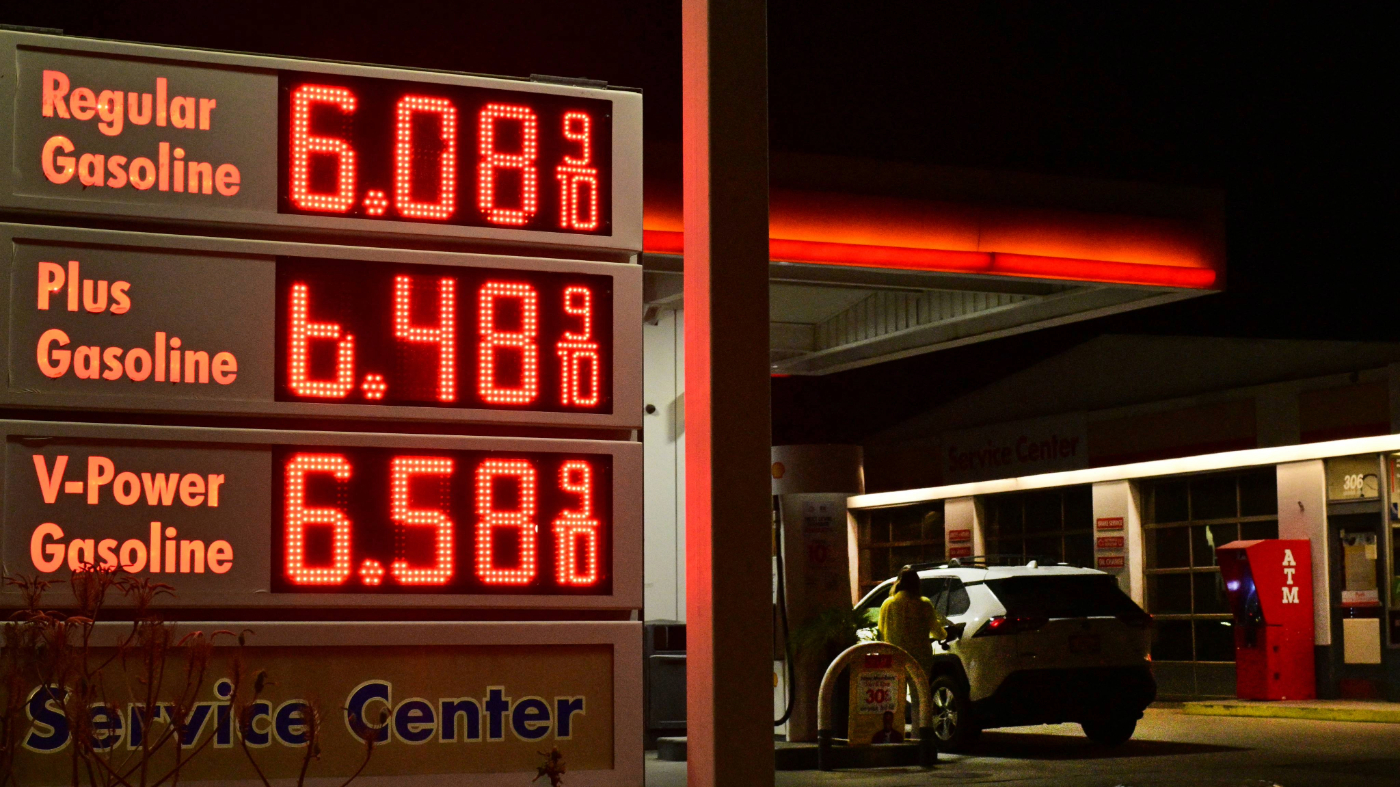
Further evidence that the Fed’s stance may be changing was Chicago Fed President Austan Goolsbee’s assessment this week that the central bank might need to tighten monetary policy if rising oil prices boost inflation. The core rate for the Fed’s preferred measure of inflation, the personal consumption deflator, is close to 3%, and it could ebb higher. The price of diesel fuel soared past $5 a gallon last week for only the second time in history, and it will filter through the economy via higher transport costs.
Meanwhile, the Organization for Economic Cooperation and Development has raised its forecast of U.S. consumer price inflation to 4.2% this year from 2.6% last year as a result of higher energy prices.
Amid this, Trump has continued to criticize the Fed for not lowering interest rates sufficiently. He is banking on his nominee for Fed chair, Kevin Warsh, sharing his vision that the economy can grow much faster without rekindling inflation. Warsh wrote an op-ed for the Wall Street Journal in November that laid out his case for lower interest rates. He argued that the Fed should discard its forecast of mild stagflation, because “AI will be a significant disinflationary force, increasing productivity and bolstering U.S. competitiveness.” Since then, the Fed upped its projection of long-term potential growth from 1.8% to 2% in its March report.
Should the Iranian conflict be unresolved when the Senate Banking Committee hearings to confirm his nomination are held, Warsh undoubtedly will be asked if his views have changed. If Warsh advocates for lower interest rates, he will have to forge a consensus among Fed members who currently are split on the issue. Meanwhile, the bond market is pricing in even odds that the Fed’s next policy move will be a rate hike or a rate cut.
Nicholas Sargen, Ph.D. is an economic consultant and is affiliated with the Darden Business School. The second edition of his book, "Global Shocks,” is forthcoming.