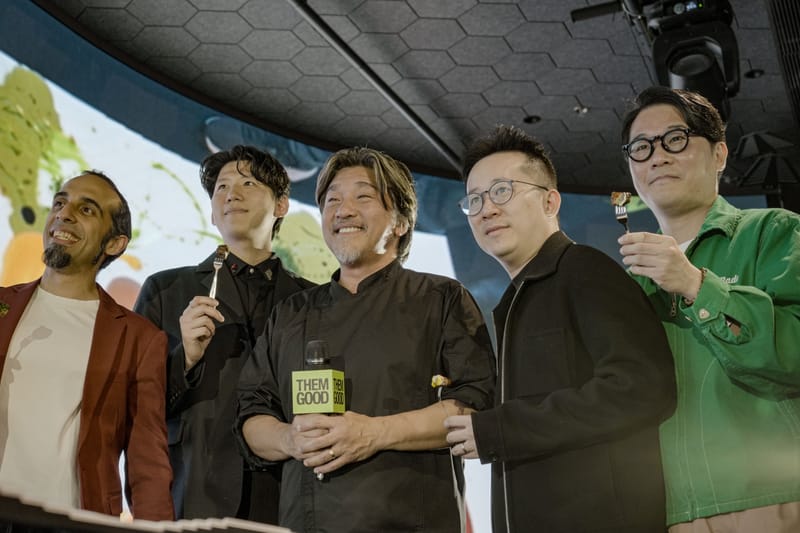
On the evening of March 25, deep into Hong Kong Art Week 2026, THEM GOOD transformed M+'s AGATE restaurant into a living laboratory of creative fiction. Fusing the worlds of art, food, mixology, architecture, and music, the evening brought together five masters of their respective crafts: Chef Edward Lee, architect Otto Ng, artist Eddie Kang, mixologist Halim Kim, and DJ Andrew Bull. The goal wasn’t only a collaboration but a "collision" — an experiment where the boundaries between permanent architecture and ephemeral consumption were blurred.
The result? A stunning, edible centerpiece co-curated by Lee and Ng, which saw guests enjoy an intricate way to consume a meal. For Otto Ng of LAAB, this project was about stepping out of the "large-scale" comfort zone. While he usually designs entire restaurants, this time he shrunk his focus to the palm of a hand, creating the Harbour Plate — a 12-foot sculptural vessel inspired by the iconic Victoria Harbour.
Chef Lee approached the collision with a student’s curiosity. Working with Ng’s three-dimensional landscapes forced him to rethink the very nature of plating. "[Ng’s] medium is space, design, and three-dimensional landscapes. The landscape that he did is very interesting because it is three-dimensional, and plates are usually flat or it’s a bowl," Lee noted. "To be able to plate on something that’s sculptural three-dimensional is very interesting."
For Kang, he saw his role as providing the "narrative layers" that people feel rather than see. As he saw it, the collaboration proved that the "blueprint" of an event isn’t always a physical document, but a shared emotional atmosphere. "Architecture, food, drinks, and music all have their own narratives," Kang explained. "When these come together, people don’t think about each part. They just feel one atmosphere".
It was mixologist Kim who brought a sense of balance to the "collision" through the concept of his drinks for the evening: Yin and Yang. His contributions, titled "Shadow" and "Bloom," were designed to be incomplete on their own, only finding unity when experienced together. "My drinks are built on this idea... Individually, they are incomplete — but together, they become a single narrative," Kim said, noting that HIS inspiration often came from the "imperfections" found in Kang’s art.
As the musical curator, Bull viewed the space as his most formidable partner. In a room defined by precise architectural lines, he treated every surface as a reflection of the sound itself. "The venue is absolutely a collaborator," Bull remarked. "The building listens back... it’s the sixth collaborator, and probably the most unforgiving one". "The venue is absolutely a collaborator," Bull remarked. "The building listens back... it’s the sixth collaborator, and probably the most unforgiving one".
Eddie Kang: "I think we all bring our own stories. It’s not only artists who tell stories; architecture, food, drinks, and music all have their own narratives. When these come together, people don’t think about each part. They just feel one atmosphere".
Otto Ng: "For me, it’s about celebrating a diversity of talents in the same space. Although we are from different disciplines, the common denominator is the artistic pursuit in our own forms. We aren’t trying to force a single, unified atmosphere. Instead, we’re layering different senses so that when they finally intersect, people can find their own harmony in the chaos". Halim Kim: "Whether it is something we eat and drink, something we see and hear, or even the space we inhabit in this world — everything carries its own story. This project was less about aligning around a single, fixed answer, and more about expanding a shared narrative through individual interpretations".
Edward Lee: "I wanted to do something interesting in my field of expertise, so we created sauces. I wanted to think about how food is very temporary. We spend so many hours making beautiful food, and then people eat it in minutes or even seconds. There’s always a temporary nature of food. And unlike most other arts, food is here and then it’s gone. So we wanted to kind of celebrate that aspect of it. There’s a bit of an unpredictability and randomness to this experiment as well".
Kang: "The space gives everything a strong background. M+ has a clear identity, so whatever happens inside feels more focused and meaningful. It helps connect all the different elements together". Ng: "M+ itself is an ever-evolving museum. Every time I visit, it feels completely new—the light shifts from day to night, the exhibitions rotate, and the crowd’s energy changes the vibe". Kim: "Architecture and art may appear permanent, but ultimately they exist as emotions translated through the viewer. And those emotions are neither identical nor fixed. Depending on who experiences them, when, and under what conditions, the same work can be remembered in entirely different ways".